
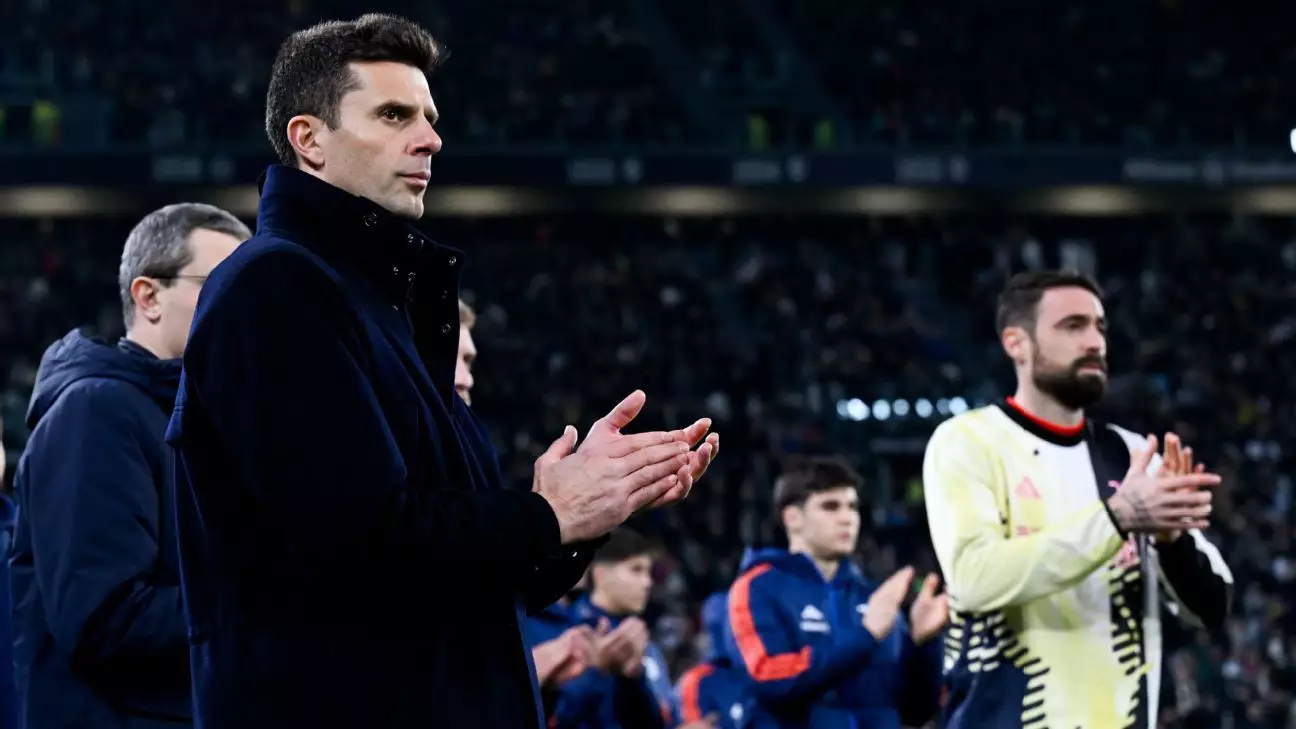
In the world of football, accountability is a concept that carries immense weight. For both players and coaches, accountability often manifests in the form of public statements after unfortunate results. This was starkly illustrated by Juventus’ head coach, Thiago Motta, following the team’s disappointing exit from the Coppa Italia against Empoli, a team perilously close to relegation. In a passionate address, he expressed feelings of shame and a desire for the players to mirror that sentiment. Such a proclamation not only reveals his emotional investment but also raises critical questions about the nature of accountability in professional sports.
Motta’s statements hint at an emotional and moral dimension that seems somewhat out of place. “We have hit rock-bottom,” he declared, emphasizing the gravity of the situation. However, where does the balance lie between motivating players and placing an undue weight of guilt upon them? By asking for apologies to the fans and the storied history of the club, Motta risks alienating the very individuals whose performance he claims to critique.
The Danger of Public Criticism
One of the most controversial aspects of Motta’s comments was his overt public critique of the players’ attitude and effort. In doing so, he replaces a more constructive approach with one that sharply divides the team and management. Labeling certain players as “those who take without giving” is a hazardous tactic; it creates speculation and inevitably sows discord among team members. Instead of fostering a united front, such comments place players under the spotlight for their perceived shortcomings, while Motta himself remains protected behind a veil of righteousness.
Furthermore, this instance raises a significant question: If the players displayed a lack of attitude in the match against Empoli, did they similarly exhibit a poor attitude during their previous drubbing against PSV Eindhoven? Untangling this inconsistency poses challenges for both the coaching staff and the players. A dissonance in perceived performance creates doubt not just about the players’ capabilities but also about the tactical decisions made by the coach.
Another disconcerting element of Motta’s post-match rhetoric involved personal judgments about life and attitude. While fostering a strong team culture is critical, framing a professional sports team in moralistic terms can come across as patronizing, particularly to adult professionals. The players are not children in need of a motivational speech; they are skilled athletes who require tactical guidance and support. By veering into self-help territory, Motta risks undermining his professional authority and distorting the focus of team dynamics.
Moreover, such statements seem to ignore the complex realities that professional athletes face, both on and off the pitch. It’s vital for coaches to remember that issues related to performance are multifaceted. A failure to contextualize their shortcomings—both individually and as a collective—only harms the environment where player development and improvement should thrive.
The Broader Issues at Juventus
Motta’s reaction is symptomatic of deeper problems plaguing Juventus. Performance never occurs in a vacuum; it is often influenced by a broad range of factors, including, but not limited to, financial constraints, recruitment strategies, and prior management legacies. Juventus has experienced a tumultuous period, characterized by substantial financial losses and persistent injury woes among key players. These challenges compound the difficulties faced by the current coaching staff.
The high-profile nature of recent signings that have underperformed, alongside ongoing injury issues, adds to the pressure on Motta and his team. Questions around the management’s overall vision for the club rise to the fore. How does Motta’s moralistic approach align with the tactical approaches needed to guide Juventus back to its former glory?
Ultimately, there is an urgent need for balanced communication within Juventus. While performance accountability is essential, it should ideally promote a healthy dialogue aimed at growth rather than fostering public discussions filled with shame and disappointment. Being open about shortcomings is critical, but this should not come at the expense of team unity or morale.
While Thiago Motta’s intention to instill accountability and address poor performances is commendable, the manner in which he has gone about it is fraught with pitfalls. The key to effective leadership lies in guiding players constructively rather than berating them publicly. Juventus stands at a crossroads, and the solutions to their problems will demand foresight, tact, and above all, unity—qualities that should be emphasized over moral outrage and expressions of shame.