
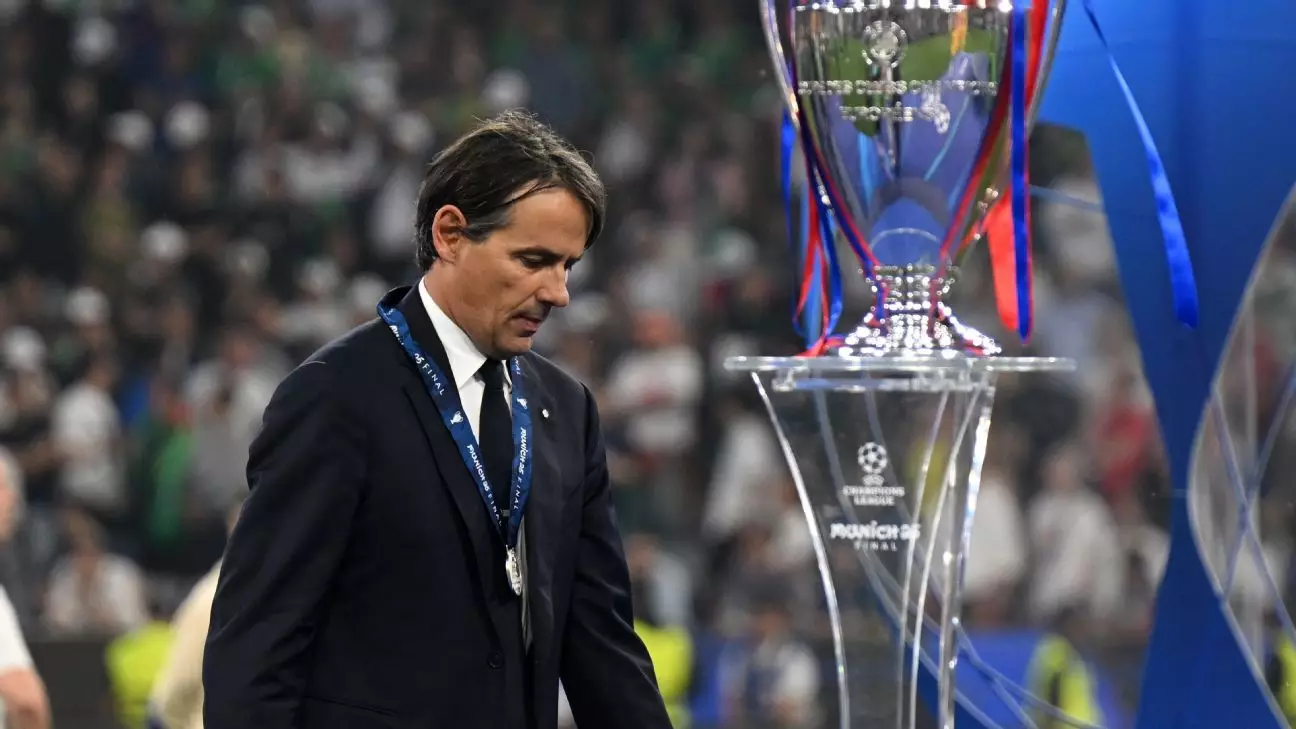
The recent Champions League final saw Inter Milan facing off against Paris Saint-Germain, resulting in a staggering 5-0 defeat for the Italian club. As the dust settles on Munich, the spotlight has shifted to coach Simone Inzaghi, who now finds himself in precarious waters. His future with the club is uncertain, and with the FIFA Club World Cup looming in June, fans and pundits alike are left wondering: will he continue to steer the ship or will Inter look for a new captain in these turbulent times?
Inzaghi’s reluctance to confirm his future with Inter Milan following such a disheartening match is anything but surprising. The weight of expectations, especially after a season filled with both highs and lows, seems to be pushing the coach toward the brink. Up against talks linking him to a lucrative position in Al Hilal, a Saudi club, Inzaghi is now treading carefully in public. His silence invites speculation and concern among the supporters who have witnessed the team’s dramatic decline in performance on one of the biggest stages in football.
A Historic Loss and its Implications
This defeat marked not only a low point in Inzaghi’s tenure but also secured Inter Milan’s place in history for the wrong reasons, registering the largest losing margin in a Champions League final. The team looked overwhelmed and underprepared, outclassed by a markedly superior PSG. Such a performance calls into question not only the tactical acumen of the coaching staff but also the heart and tenacity showed by the players on the pitch.
While failures can serve as crucibles for growth, Inzaghi’s comments about pride in the team’s Champions League campaign feel hollow in light of such a staggering loss. It’s admirable to look back at the journey taken to reach this stage, but the disappointing conclusion leaves a bitter taste. PSG’s earlier conquests in their league gave them a depth of tactical familiarity and readiness that Inter simply did not possess, showcasing how crucial preparation and resting players are ahead of critical matches.
With Inter facing Monterrey in the Club World Cup set for June 17, the team must quickly pivot from the despair of defeat to the opportunism required for future challenges. Inzaghi’s comments hint at an understanding of the broader implications, as he acknowledged, “Defeats can make you stronger,” yet one must question whether strength can emerge when the foundations of leadership appear shaky.
How Inzaghi navigates the interviews and interactions in the weeks to come will be pivotal. If he remains at the helm, he must carry the burden of expectation and disappointment while reigniting the ambition within his squad. If the board decides to part ways with him, the questions remain: who would be a suitable replacement, and can the club afford to risk further instability so close to a high-stakes international tournament?
In short, the road ahead for both Inzaghi and Inter is laden with challenges—some self-inflicted and others born from the situation posed by a supremely dominant opponent. Leadership in football is as much about navigating setbacks as it is about celebrating triumphs, and right now, the path of resilience is one that both Inzaghi and his players must learn to embrace.