
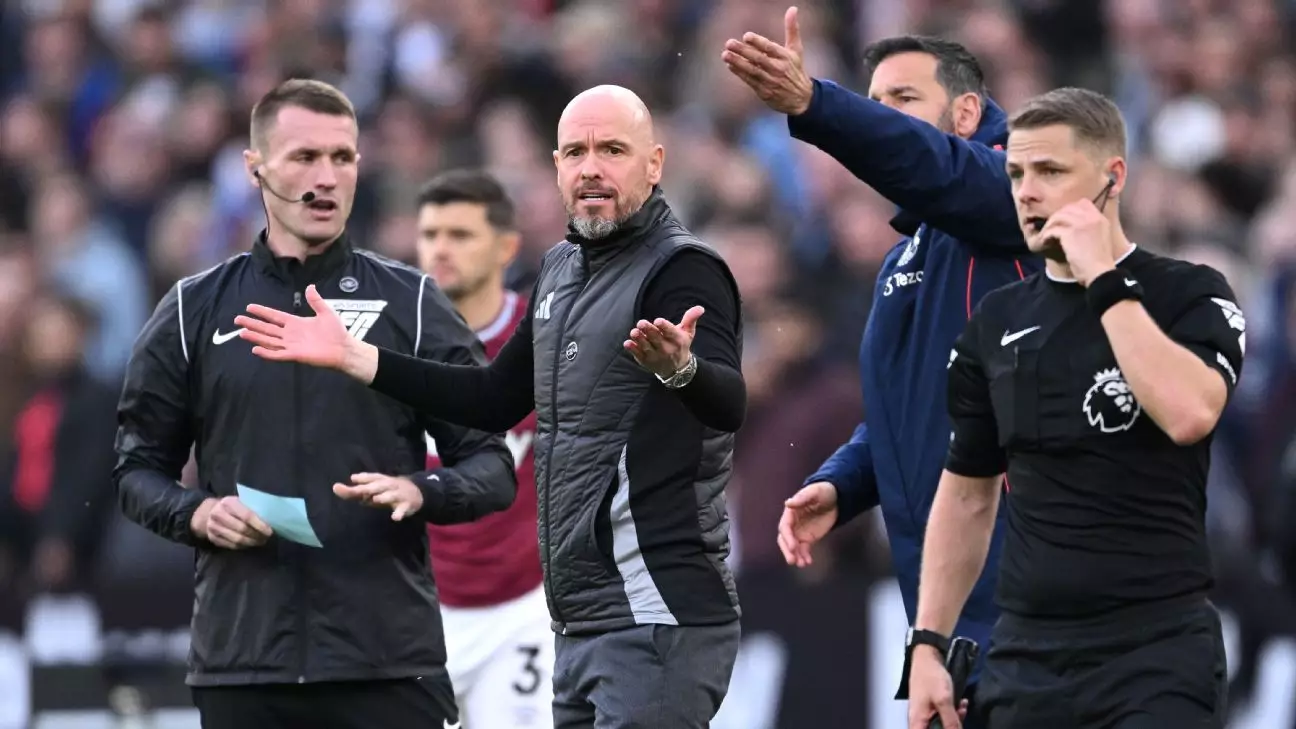
The woes of Manchester United reached new depths when they succumbed to a 2-1 defeat against West Ham United, a team that has historically not posed a significant threat. While it may be tempting to focus solely on the controversial penalty given against them in the dying moments, the reality is much more profound. Erik ten Hag and his team’s inability to maintain their lead paints a troubling picture. The team’s performance journey, punctuated by occasional brilliance, now more frequently illustrates disarray and missed opportunities.
After a promising start where United initially appeared in control, the match radically shifted following a clumsy moment from Matthijs de Ligt. The timing of Ings’ penalty kick was unfortunate, but greater issues lurked beneath the surface. Ten Hag’s insistence on blaming officials rather than addressing the core problems reaffirms a culture that may ultimately hinder the team’s growth. The red card given to Bruno Fernandes, which was later rescinded, may have been the crux on which Ten Hag found solace, but it cannot overshadow a string of concerning performances and missed chances that characterize their season.
Erik ten Hag’s philosophy appeared apparent in his statements post-match, yet reality diverged significantly from his vision. Rather than owning up to the deeper structural and tactical concerns, he chose to dwell on officiating errors that he believed influenced the outcome. The manager’s repeated focus on VAR decisions betrays a reluctance to confront the team’s glaring shortcomings — not least their inability to convert chances into goals.
Statistics from this match reveal a critical contrast in expected goals (xG) between United and West Ham. United held an xG of 1.48 while West Ham’s was a meager 0.04 at half-time. Yet, despite this dominance, they walked away with nothing to show. This serves as an embodiment of their current plight: dominating matches in terms of possession and chances but failing to finish. Such inefficiencies cannot solely be attributed to bad luck or officiating, raising questions about the players’ mentality and the coaching staff’s effectiveness in instilling the requisite hunger to succeed.
As the match against West Ham unfolded, discomforting parallels emerged within the squad — from Bruno Fernandes ballooning a straightforward header over the bar to Diogo Dalot’s astonishing miss from six yards out. One must question the mentality held by players touted as the future stars of the club when they continually squander opportunities. Alejandro Garnacho, for instance, despite his youthful exuberance and potential, holds modest statistics in terms of goal contributions, further reflecting a lack of cutting edge.
It’s troubling to consider that a team with historically high expectations now boasts only eight goals from nine matches — a harrowing statistic for any Manchester United side. This output demonstrates a stark contrast to their storied past. Ten Hag dared to claim that they played “good football” in the first half against West Ham, yet with mounting pressure and a lack of composure, the words ring hollow amidst the cacophonous atmosphere surrounding the club.
Ten Hag articulated the importance of maintaining composure after missing opportunities, yet one must wonder whether the players possess the capacity for such self-regulation — especially in moments of crucial decisions. If they persist in overlooking clear scoring chances, can they genuinely reclaim their status among England’s elite?
As they brace for upcoming matches against Chelsea, Leicester City, Ipswich Town, and Everton, the need for a turnaround becomes paramount. These aren’t just fixtures; they are potential turning points that could either anchor their season or spiral it further into chaos. Ten Hag cannot afford continued disappointment.
While there will undoubtedly be observers bearing witness to Manchester United’s struggles, it is vital to recognize that such challenges are not insurmountable. Football is often cyclical, and should Ten Hag grasp the opportunity to correct course by addressing performance issues rather than outwardly blaming external factors, there remains hope for a revival.
In time, Manchester United’s commitment to recalibration must become evident. The road ahead may be fraught with obstacles; it appears that self-reflection will be key. After all, the greatest potential for transformation comes from acknowledging imperfections before fortifying strategies for resurgence. Only then can the echoes of past success resonate once more within the hallowed Old Trafford.