The Enigmatic Role of VAR in Premier League Controversies
Video Assistant Referee (VAR) has become a focal point of debate in the English Premier League, often perceived as a disruptor rather than a facilitator of fair play. Each week, fans are treated to a display of contentious decisions that evoke a spectrum of emotions: frustration, anger, disbelief, and sometimes—rarely—satisfaction. As we delve into some of the more perplexing recent instances, we seek to understand how decisions are made and whether or not they align with the spirit of the game.
VAR was introduced to enhance the accuracy of officiating in crucial moments of a match, primarily focusing on goals, penalties, and straight red cards. However, its introduction has not simplified matters; rather, it seems to have transformed officiating into a contentious realm where subjective interpretation takes precedence. The Premier League’s high bar for intervention often results in the VAR upholding on-field decisions, regardless of public outcry.
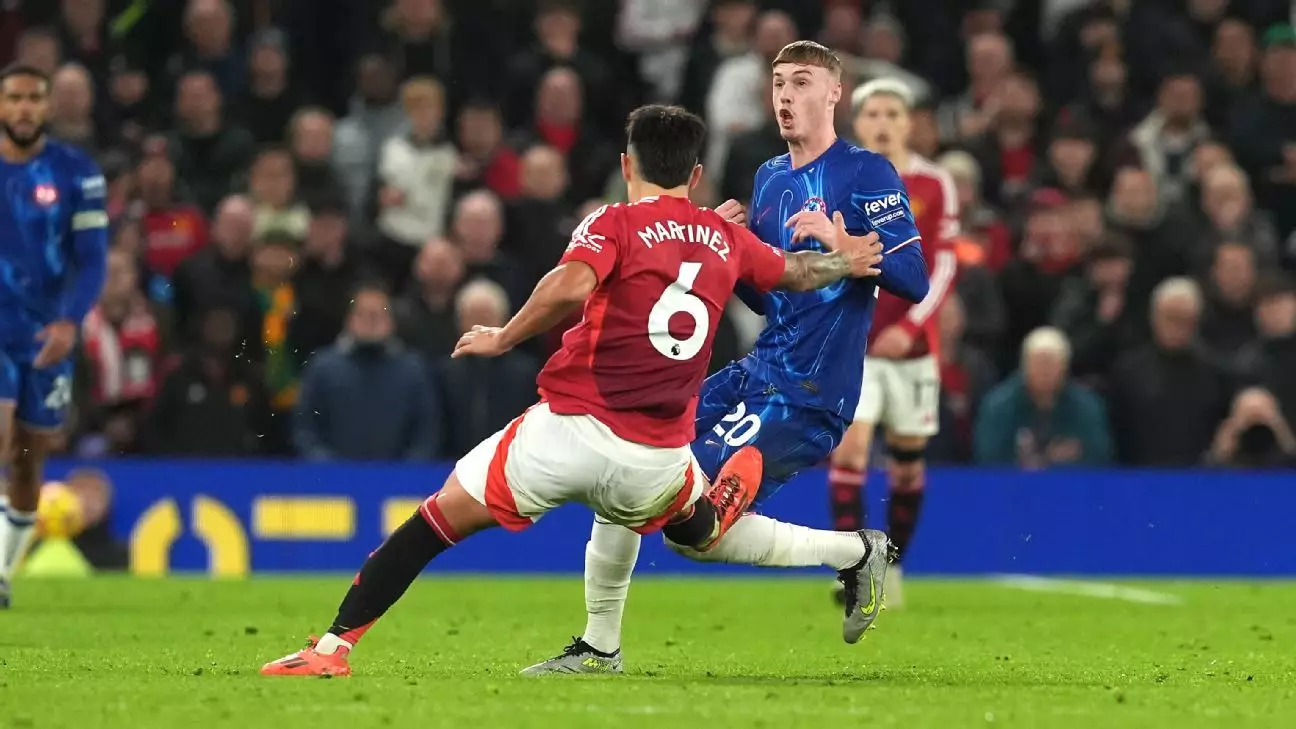
This is exemplified in the case involving Manchester United’s Lisandro Martínez and Chelsea’s Cole Palmer. During a crucial moment of the match, as Palmer sought to maneuver around Martínez, the latter executed a challenge that caught Palmer around the knee with his studs visible. Referee Rob Jones opted for a yellow card, which VAR reviewed but ultimately upheld, sparking debate about the severity of the foul. Historically, Premier League video referees have been hesitant to overrule on-field decisions, reflecting a broader philosophy that seeks to maintain the authority of the match referee.
A significant takeaway from the Martínez incident is the consistent inconsistency regarding what constitutes serious foul play. The statistics suggest a troubling trend: only 62.5% of serious foul-related red cards have been accurately adjudicated through VAR. This raises questions about whether the system is equipped to handle the volatility of human judgment in football. Instead of uniformly enhancing fairness, VAR has become a tool that often reinforces the referee’s original intention, even in instances where a more stringent interpretation might be warranted.
Staying with the theme of penalties, another controversial incident unfolded when Manchester United were awarded a penalty following a challenge from Brighton’s Robert Sánchez on Rasmus Hojlund. Upon review, the VAR found sufficient contact to keep the penalty on the books, leading to further discussions about how VAR determines “sufficient contact” in situations subjected to interpretation.
The threshold for what is deemed acceptable seems to vary not only across different teams but can also shift dramatically between different matches. For fans and analysts alike, the implications of these seemingly arbitrary standards create an atmosphere rife with skepticism about the validity of VAR interventions.
Perhaps no team has faced more VAR scrutiny this season than Ipswich Town, who have not been awarded a single favorable decision in their matches. Following a sequence of events where a potential penalty was denied against them, club officials expressed frustration with the system. The sentiment that Ipswich is being victimized by VAR suggests a systemic issue: when teams lack favorable calls, their faith in the technology diminishes. Such sentiment only exacerbates the narrative that VAR is inconsistent in its execution.
Critically, Ipswich’s case underscores a larger problem within the application of VAR; refereeing decisions often reside within subjective interpretations of the game. As evidenced by the VAR panel ruling in favor of the onfield officiating despite the perceived injustices faced by Ipswich, there’s a risk that VAR could further alienate clubs and fans who feel as though they are being unfairly treated.
Red Cards and the DOGSO Controversy
The concept of Denying an Obvious Goal-Scoring Opportunity (DOGSO) has become a recurring topic in discussions about VAR interventions. Several recent cases, including those involving Southampton’s Jan Bednarek and Everton’s Beto, have exemplified the confusion surrounding what constitutes a DOGSO. In instances where a clear scoring opportunity was denied, many supporters believe that the VAR should have intervened to overturn the referee’s initial call. However, the reluctance to apply stricter measures has left many feeling as though there is a fundamental imbalance in how rules are enforced.
In the case of Crystal Palace’s disallowed winner against Wolverhampton, the VAR’s decision hinged on whether a goalkeeper was deemed to be in control of the ball, which in itself is another subjective element that seems to baffle both players and fans. The consensus was that despite the chaotic nature of the situation, VAR upheld the referee’s call—largely through the lens of perceived control by the goalkeeper, a concept often muddied and confusing to onlookers.
Ultimately, VAR exists within a framework that is inherently susceptible to interpretation. While designed to reduce controversy and improve decision accuracy, its rollout has resulted in a convoluted entanglement of rules, interpretations, and human judgment—a far cry from its intended purpose. The challenge moving forward will be to refine not just the technology but the entire approach to officiating in football to foster trust and fairness in what is often a beautifully chaotic game. The hope is that VAR will one day evolve into a tool that not only enhances fairness but restores the spirit of competition, free from the dreaded specter of controversy.