
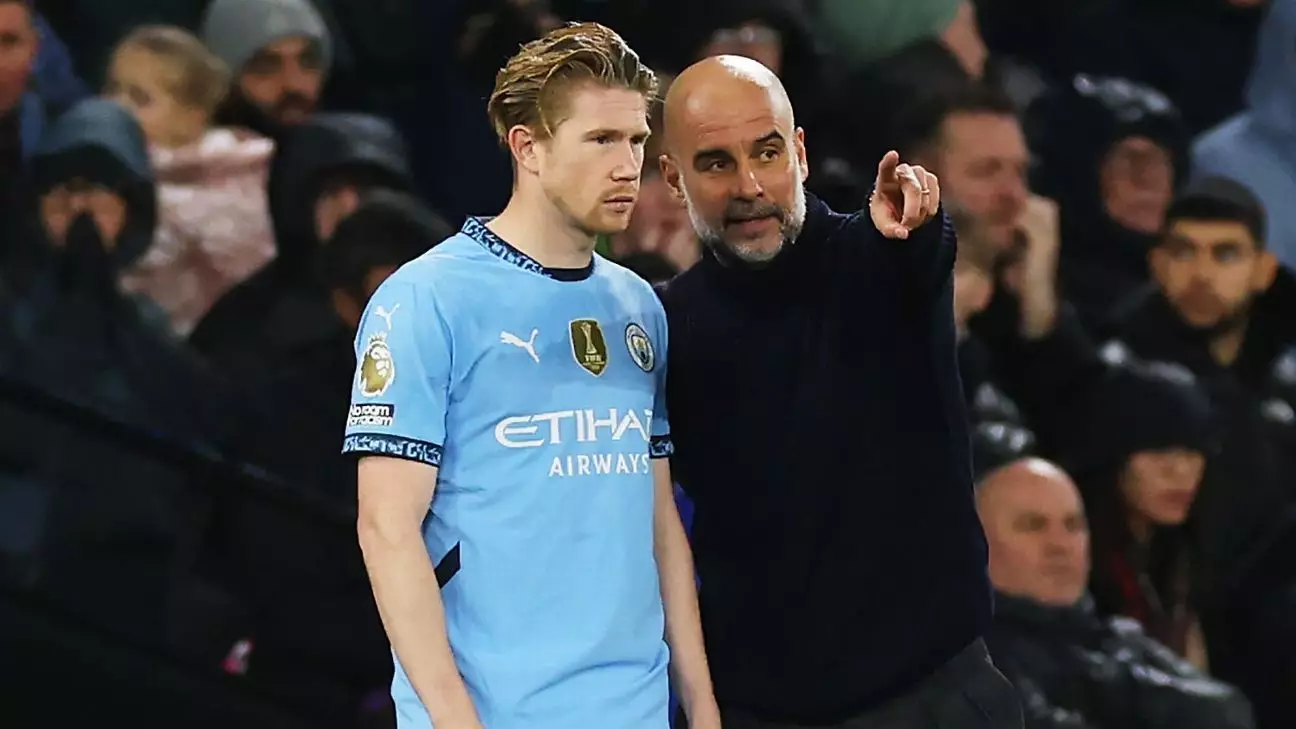
In the high-stakes world of professional football, narratives often twist and turn based on performances, injuries, and managerial decisions. One scenario capturing the spotlight is Kevin De Bruyne’s perplexing position in Manchester City’s lineup under Pep Guardiola, especially following De Bruyne’s return from injury. The discussions surrounding De Bruyne’s restricted playtime have sparked intense speculation regarding a supposed rift between the player and the manager. However, a closer examination of Guardiola’s recent comments reveals a multi-layered story.
One of the primary causes for the current workload of Kevin De Bruyne, who has taken on a limited role with only five substitute appearances since his return from an abdominal injury, is, quite simply, the injury itself. Having been sidelined for an extended period, it is crucial to understand that rehabilitation and recovery can significantly impact a player’s form and fitness level. Guardiola’s statement highlighting De Bruyne’s age—33 years—suggests an acknowledgment of the wear and tear that professional athletes endure. At this juncture, the City manager seems committed to recalibrating De Bruyne’s contributions, knowing that a rushed reintegration could backfire.
Guardiola’s assertion that “he needs time to find his best” is a beacon of awareness rather than dismissal. The intricate balance between protecting a player’s health and leveraging their talents is essential in a sport that can often prioritize immediate results over long-term welfare. This perspective becomes even more critical as clubs, including Manchester City, navigate the demanding schedule of the Premier League.
The pairing of Sky Sports pundits Gary Neville and Jamie Carragher has sparked heated discussions regarding perceived discord among the Manchester City players and management. Press reactions often amplify situations, creating conjecture where facts may be scant. Neville referred to the situation as “unusual, bizarre, strange,” while Carragher shared similar sentiments, indicating a deeper issue at play if De Bruyne were indeed fit and not starting.
However, it’s imperative to discern where these speculations stem from. Pundits thrive on narratives that can attract viewership, and in high-pressure environments like those surrounding City, interpreting a manager’s decision as indicative of a rift is an easy leap to make. Yet, while their concerns are somewhat valid, they often miss the nuance present in player management, especially regarding an asset like De Bruyne, who has indeed been integral to City’s past successes.
Guardiola took the initiative to clarify his stance during a recent press conference, which is commendable in a world where many managers choose to remain ambiguous. His emphasis on the importance of De Bruyne’s talent speaks volumes about how highly he regards the Belgian midfielder. When speaking to the media, Guardiola decisively said he would never want to sideline De Bruyne, emphasizing the long-standing success they’ve enjoyed together.
He also pointed out a critical distinction: the team’s collective responsibility. No single player, including De Bruyne or star striker Erling Haaland, can independently resolve the broader challenges that City currently faces. This view reflects Guardiola’s understanding of modern football’s complexities, where collective performance often outweighs individual brilliance.
As Manchester City prepares for their upcoming match against Nottingham Forest—a team currently holding a respectable sixth position in the league—the role of De Bruyne becomes one of the focal points of interest. Guardiola hinted at the possibility of De Bruyne’s enhanced involvement, now that he has logged some minutes on the pitch at Anfield.
Yet, the manager’s warning that De Bruyne “will not solve our problems” underlines the pressing reality that the club must collaborate as a unit, shouldering defensive responsibilities just as much as they seek to attack. This balanced perspective is invaluable in a sport that can often reduce complex scenarios to overly simplistic narratives.
The ongoing discourse around Kevin De Bruyne exemplifies the intricacies of player management. While speculation continues to swirl, both Guardiola’s strategic insight and the recognition of De Bruyne’s long road to recovery are testaments to the broader narrative of management in professional football. The future may still be bright for De Bruyne and City, but it requires patience, cohesion, and time. As often echoed in the sport, the most compelling stories are those that unfold over time.