
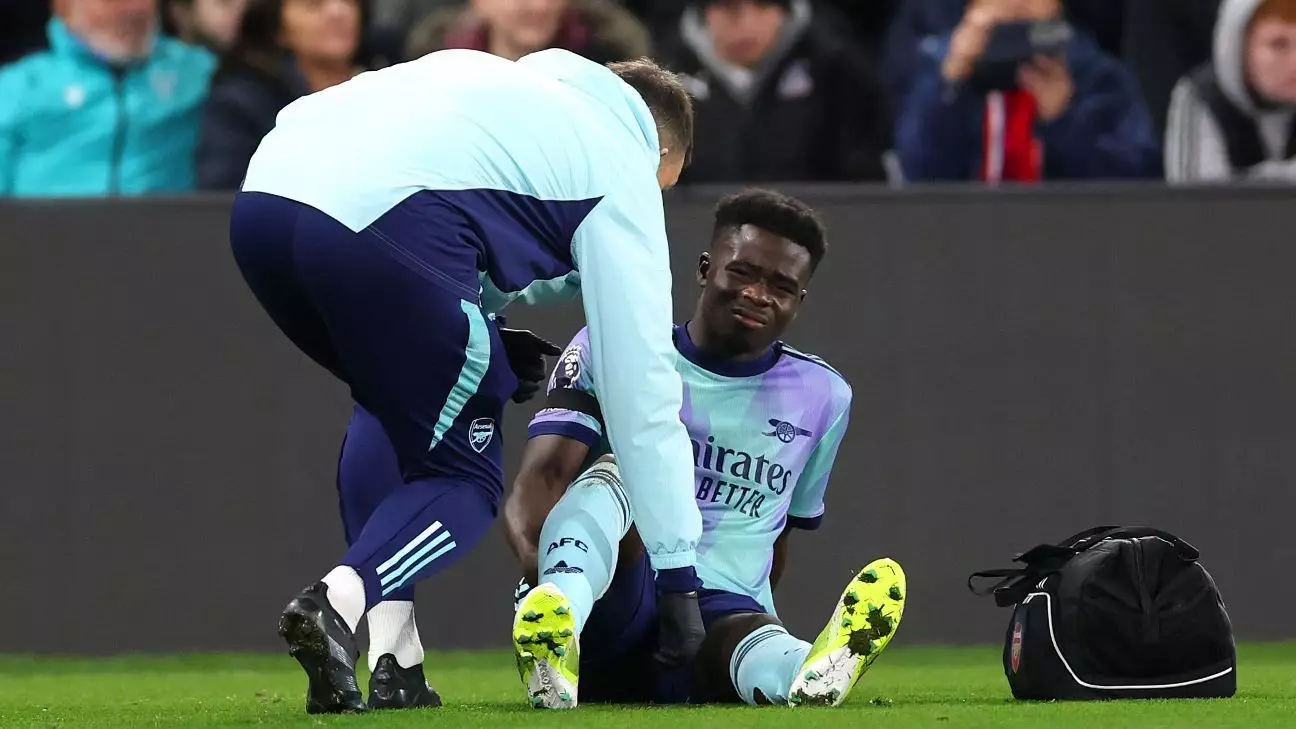
The recent news surrounding Bukayo Saka’s injury has cast a shadow over Arsenal’s rising momentum in the Premier League. Surgical intervention on a hamstring tear, which Saka suffered during the first half of a hearty 5-1 victory against Crystal Palace, will leave the 23-year-old star on the sidelines until at least March, according to Arsenal manager Mikel Arteta. Though Saka’s surgery reportedly went smoothly, Arsenal fans and stakeholders must grapple with the implications of losing a pivotal player for an extended spell.
Saka’s absence is particularly concerning for a team that has bestowed considerable reliance on his dynamic skill set. In Arsenal’s most recent match against Ipswich, the Gunners labored against a lower-tier opponent, managing only a solitary goal from Kai Havertz, which propelled them to second place in the Premier League standings—six points behind leaders Liverpool. This highlights a disconcerting trend: the team seems to struggle without Saka, whose ability to create chances and drive the ball forward adds a crucial layer to Arsenal’s attacking strategy. Without key players like him, the Gunners may find it increasingly difficult to maintain their competitive edge.
During a press conference following the win against Ipswich, Arteta was transparent about Saka’s rehabilitation timeline. Instead of offering an optimistic quick-fix, he acknowledged the probable duration of recovery, suggesting that Saka would be absent for “many weeks” and possibly more than two months. The manager’s insights provide a realistic assessment of the situation but also reinforce the gravity of Saka’s injury. The uncertainty surrounding healing progress and mobility raises concerns over whether the team can adapt quickly enough to fill the void left by their star forward.
While the injury news about Saka appears severe, there is at least a flicker of hope for Arsenal supporters regarding Raheem Sterling’s condition. Initial fears suggested that Sterling’s knee issue could lead to a lengthy absence, but Arteta shared more optimistic updates. The evolution of Sterling’s injury seems promising, which could provide a much-needed boost to the squad. Should Sterling recover in time to feature prominently in the team’s tactics, it would alleviate some pressure off the remaining forwards to compensate for Saka’s absence.
As Arsenal navigates through this uncertain phase, the management and players must now strategize for the coming weeks without one of their most instrumental players. The team’s depth will be tested, and Arteta’s tactical ingenuity will be paramount in ensuring that Arsenal remains competitive in both domestic and international fixtures. How effectively they can adapt and adjust will likely determine their fate in the months leading up to Saka’s anticipated return. The journey is undoubtedly challenging, but the hope lies in the resilience and tenacity that the team can muster in his absence.