
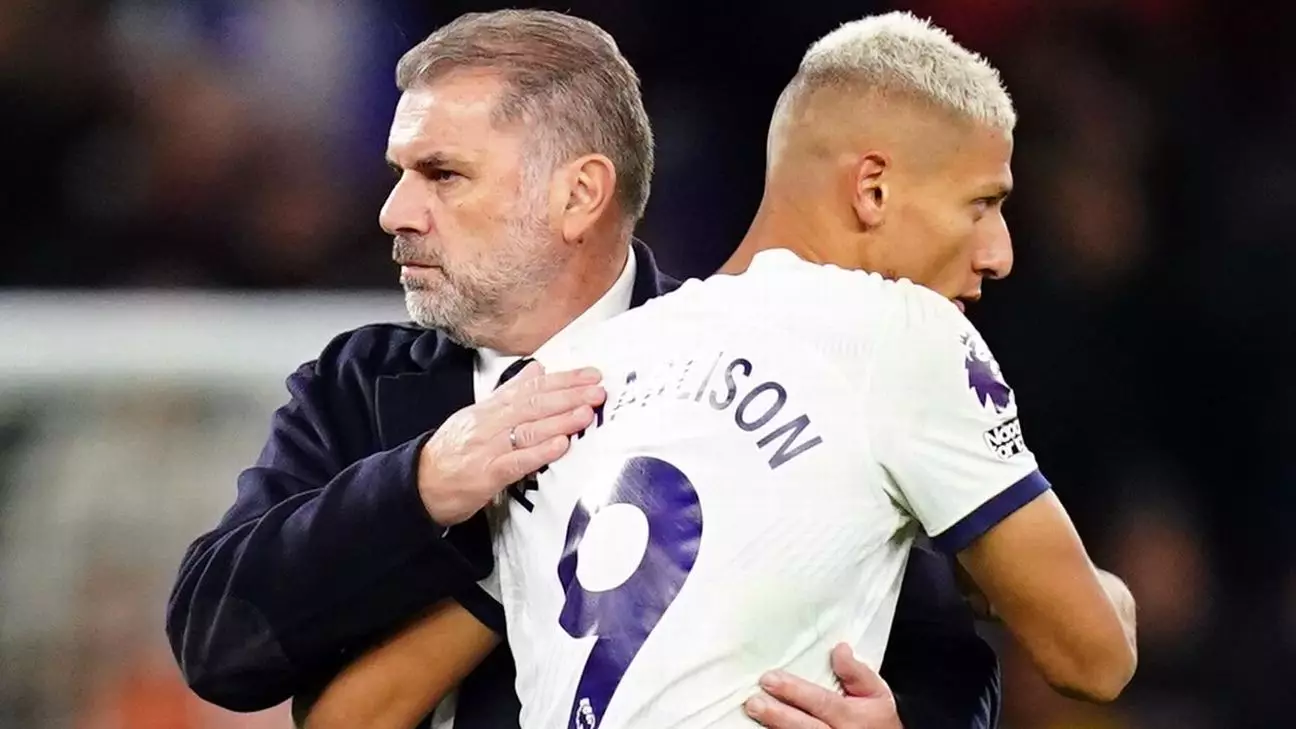
Ange Postecoglou, manager of Tottenham Hotspur, recently voiced his concerns regarding the pressing need for additional forward options in light of Richarlison’s continuous struggles with injuries. The Brazilian forward, who is 27 years old, is currently sidelined with a “significant hamstring injury,” having only just returned to the pitch after a troublesome two-month recovery from a groin issue. This history of injuries—encompassing calf, hamstring, and knee problems—generates legitimate doubts about Richarlison’s reliability as part of Spurs’ attacking setup.
Richarlison’s inability to maintain fitness over extended periods raises concerns, effectively leaving the team in a precarious situation regarding their offensive prowess. The recent match against Fulham saw Spurs field Son Heung-Min as a makeshift centre-forward due to a number of injuries plaguing the squad. Alongside Richarlison, Dominic Solanke’s illness and the absence of summer signing Wilson Odobert, who recently underwent hamstring surgery, has left the team looking thin in offensive positions.
The absence of promising young talent, such as Mikey Moore—who is battling a virus—further limits Postecoglou’s options. The uncertainty on the squad’s attacking front begs the question: How will Spurs adapt to these injuries and find an effective solution? In response to inquiries about bolstering the forward line, Postecoglou candidly acknowledged the need for reinforcements. His statement underscores an emerging trend in football management, where adaptability and foresight become imperative in navigating a season fraught with injuries.
The Spurs boss noted, “Even with Wilson and Mikey’s absence, we have to consider our options because the demands of the game are relentless.” This frank admission points to the tactical flexibility he must implement in the immediate future to ensure that the team remains competitive, especially with the January transfer window approaching.
Postecoglou’s words about Richarlison reveal both optimism and frustration. Though he sees immense potential in Richarlison—especially recalling the Brazilian’s impactful performances when fit—there lies the stark reality that the player’s inconsistent physical condition is burdening the team’s depth. He reminisces about Richarlison’s scoring run early in the previous season and his positive contributions when on the field. However, such moments are overshadowed by the immediate pressing concern: the urgent necessity to fill the gaps left by injured or unavailable forwards.
The manager’s prudent approach acknowledges that relying heavily on Solanke could inadvertently lead to fatigue, which would ultimately diminish performance levels. This realization adds an additional layer to Postecoglou’s planning, as he looks to devise strategies that protect his players’ fitness while maximizing their output.
As Tottenham pushes through this challenging phase, the January transfer window presents an opportunity—a chance to recalibrate the squad and invest in reliable forward options. The urgency is palpable as the club seeks to reinforce its attacking capabilities to support its ambitions this season.
Tottenham Hotspur stands at a critical juncture, with the ongoing health issues of key players necessitating thoughtful tactics, creative solutions, and potentially strategic recruitment. With a blend of emerging talents and seasoned players, the hope is that Spurs can navigate this tumultuous landscape effectively, preserving competitiveness in the demanding landscape of modern football.