
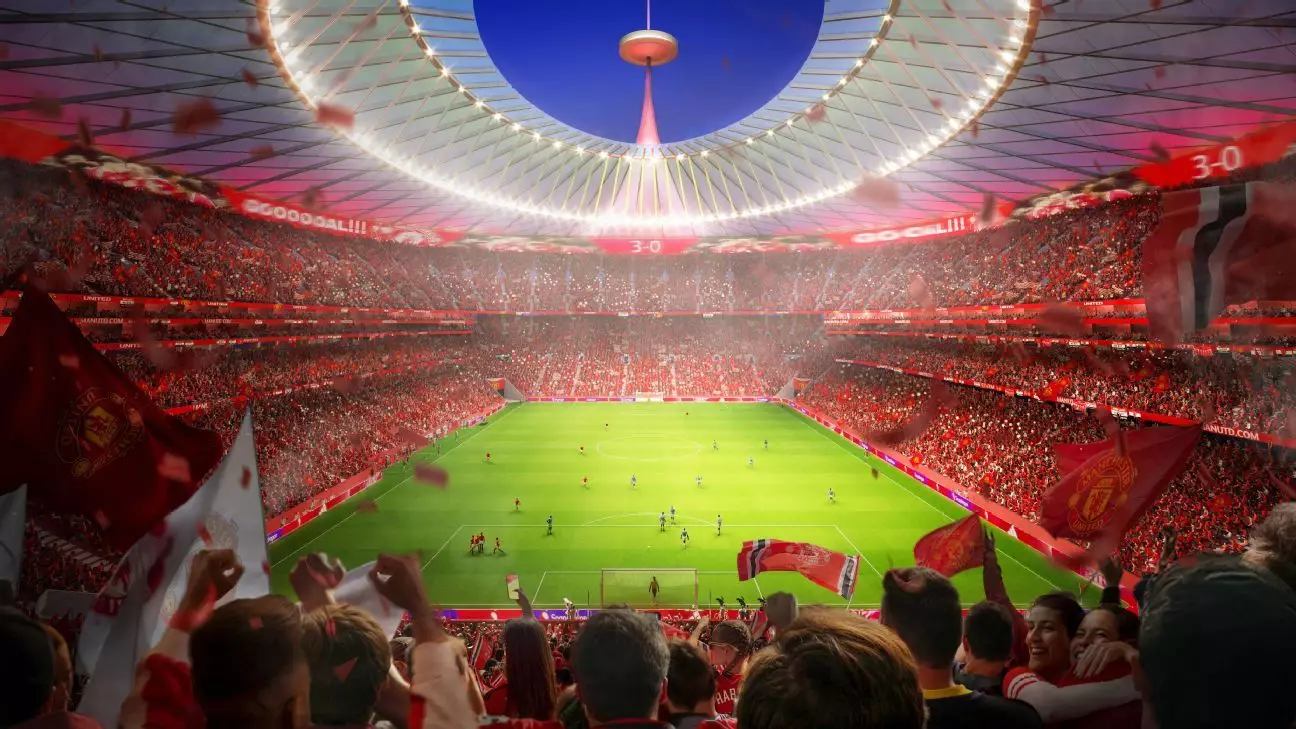
Manchester United, one of the most storied football clubs in the world, has set its sights on a bold new future by announcing plans for a state-of-the-art stadium. With United aiming to move from Old Trafford, their iconic home for over a century, into a towering 100,000-seat venue, this undertaking represents both an ambitious vision and a potential financial quagmire. The price tag of approximately £2 billion (around $2.59 billion) looms large, prompting concerns about the club’s financial sustainability and competitive viability in a fiercely challenging Premier League landscape.
Such monumental projects often come at a price, and in this case, it could be the inability to fortify the squad during a crucial developmental phase. United’s CEO, Omar Berrada, candidly acknowledged the risks entailed in this venture, suggesting that the investment might further widen the gap between Manchester United and their more financially stable rivals. With financial losses exceeding £300 million (roughly $388.57 million) over the past three years, the club’s fiscal health is already teetering on a precipice. This raises an urgent question: Can Manchester United effectively balance ambitious investments in infrastructure with the need for a competitive squad?
The Paradox of Infrastructure Investment
History offers a clear perspective on the complexities involved in stadium financing. Arsenal and Tottenham Hotspur both undertook significant stadium projects that led to difficulties on the pitch, as funds were funneled away from squad strengthening. Berrada’s admission that there is a risk involved in prioritizing infrastructure over the team’s immediate competitiveness makes it clear that United may face a similar struggle.
Fans may find it difficult to reconcile the club’s ambitions of a grand new stadium with the stark reality that player acquisitions could be compromised. The emotional investment from supporters runs deep; they yearn for silverware just as strongly as they look forward to modern facilities. The fear that the construction of a new stadium could stifle immediate success on the pitch is a bitter pill for many loyalists. Berrada’s acknowledgment of this risk is both refreshing and concerning; while transparency is commendable, it exposes the vulnerabilities that this historic club faces.
Securing Funding Without Taxpayer Support
In a bid to alleviate concerns about financial overreach, Berrada reassured the public that the club would not seek taxpayer funding for the new stadium. This decision aligns with the broader ethical considerations within football, as clubs increasingly grapple with their financial responsibilities. Instead, Manchester United is pursuing private investment to assist with funding, and plans to move into the new home by the 2030-31 season. However, as with any ambitious project rooted in extensive capital requirements, uncertainty prevails—especially with potential long wait times for planning permissions and the inherent complications in local authority negotiations.
The looming threat of running out of funds, as co-owner Sir Jim Ratcliffe recently intimated, only amplifies the stakes. The looming financial imperative casts a shadow over their ambitious aspirations, intensifying the pressure on the club to navigate this pivotal moment effectively. Moreover, it raises a poignant question: is it prudent to chase glory through construction when immediate success is increasingly elusive?
Strategic Recruitment Amid Tactical Evolution
The potential impact of these financial strains extends to player recruitment strategies as well. Berrada has indicated that there will still be funds allocated to bolster the squad, regardless of whether the team qualifies for European competitions. However, he emphasized a need for adaptability—emphasizing that the players brought in must fit into a more versatile tactical framework rather than being tied to a rigid formation preferred by new head coach Ruben Amorim.
While recruitment has strategic merit, it also illustrates a deeper thought process within the club. Embracing a vision for a more possession-heavy, attacking style suggests a departure from traditional approaches and a clear commitment to evolving the club’s identity on the field. This shift, however, must be cautiously managed as the club walks the tightrope of financial constraints and demands for immediate on-pitch performance.
The hopeful picture painted by Berrada, while layered with complexity, offers glimpses of ambition. Aspiring to transform both the stadium and the team could redefine Manchester United’s legacy in the modern football era, yet the challenge lies in executing these aspirations without compromising the immediate competitive stance essential for the club’s return to glory.