
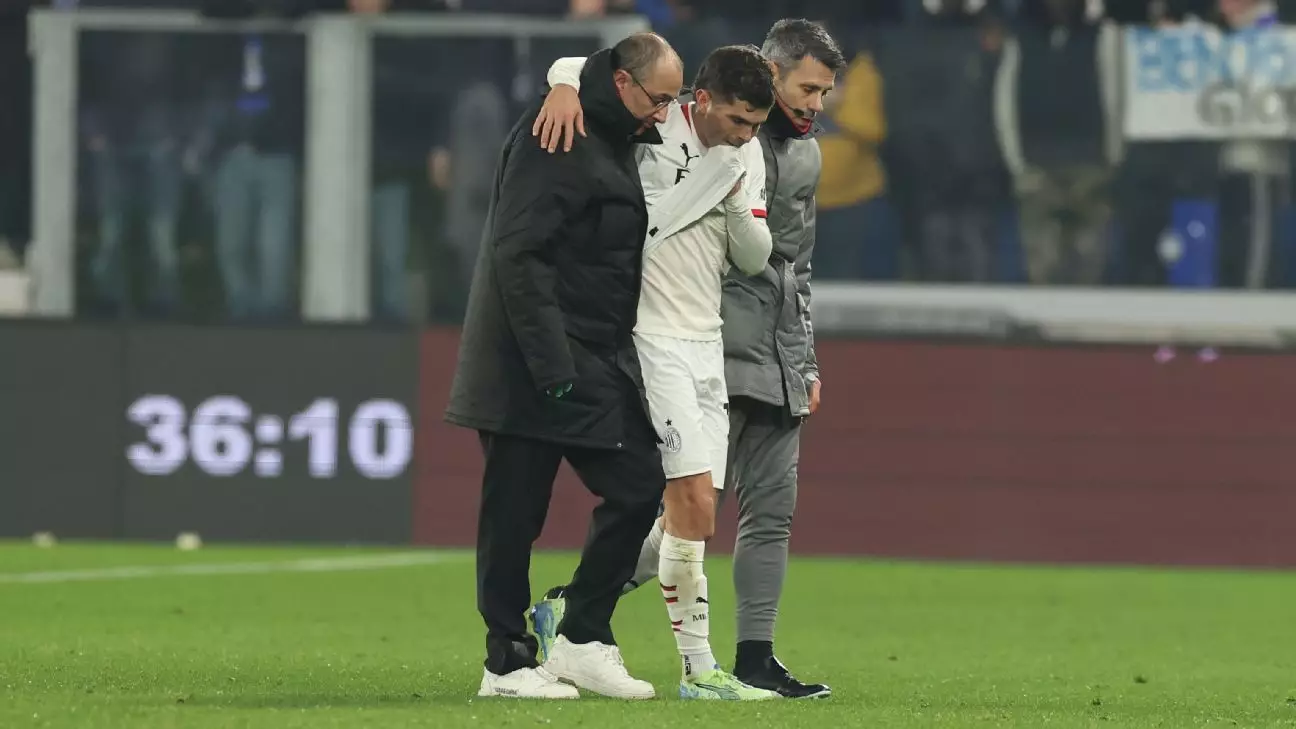
In a disheartening turn of events during AC Milan’s matchup with Atalanta, team captain Christian Pulisic exited the field due to a right calf injury. The incident took place in the first half, notably in the 38th minute, when Pulisic seemed to twist awkwardly while being challenged by Atalanta’s Mario Pasalic. Despite a promising start to the game, where Pulisic had previously attempted a shot, he found himself in visible pain, ultimately leading him to signal to the bench for a substitution. This moment not only highlighted the fragility of athletes but also brought to light the significant risks involved in high-stakes football.
The Aftermath and Managerial Insights
Following Pulisic’s departure, coach Paulo Fonseca addressed the media, attempting to quell the panic surrounding the injury. He characterized the ailment as a “minor calf strain,” offering hope that the impact may be less severe than initially feared. Nevertheless, injuries in football can be unpredictable, and what seems trivial can sometimes evolve into prolonged absences. Pulisic’s discomfort drew focus not just on his individual capabilities but also on his critical role within AC Milan as the season progresses.
Milan’s subsequent 2-1 defeat to Atalanta was compounded by the loss of their influential captain. The game, played at Atalanta’s Gewiss Stadium, was particularly frustrating as it saw Ademola Lookman score a late winner, further propelling Atalanta to the top of Serie A standings. This unexpected outcome not only disrupted Milan’s rhythm but also placed additional pressure on the team ahead of their crucial Champions League match against Red Star Belgrade. The stakes are high, and Pulisic’s absence may be felt in more ways than one.
Since joining AC Milan, Pulisic has shown remarkable promise, contributing eight goals and six assists in just 19 appearances. His presence on the pitch has often been a game-changer, exemplifying the dual role of a leader and a playmaker. As discussions about his fitness unfold, there is a palpable concern not just for Milan but for the U.S. national team as well. His ability to perform during crucial international fixtures hinges on his health, making timely recovery essential.
This incident serves as a stark reminder of the inherent risks athletes face. As Pulisic and AC Milan navigate through this challenging period, their resilience will be tested. While the initial prognosis appears optimistic, it raises questions about managing player health in the demanding world of professional sports. The hope remains that Pulisic will recover swiftly, allowing him to continue making an impact both at the club level and with the United States national team, reaffirming his place as one of football’s emerging stars.