
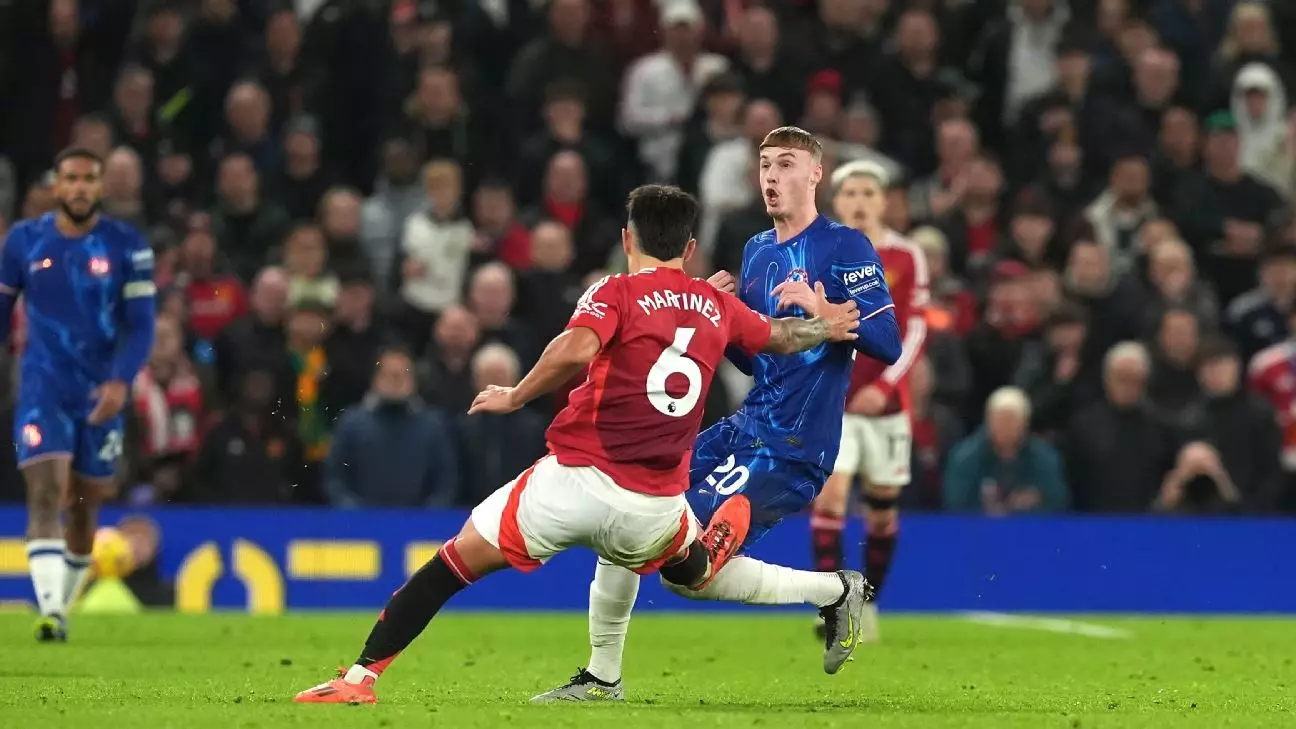
The Premier League clash between Chelsea and Manchester United at Old Trafford ended in a dramatic 1-1 draw, but it was not just the scoreline that caught attention. The match was marred by a series of contentious decisions, particularly concerning a challenge made by United’s defender Lisandro Martínez on Chelsea’s Cole Palmer. This incident has sparked discussions among players, coaches, and fans alike, as opinions diverge about the appropriateness of the referee’s actions and the responses that have followed.
Early in the match, a tackle from Martínez on Palmer escalated tensions, resulting in a yellow card but leaving many questioning whether a red card would have been more appropriate. During stoppage time, Martínez caught Palmer high on the knee—a move that immediately raised eyebrows and drew criticism. Chelsea head coach Enzo Maresca expressed his discontent, asserting that the challenge was reckless and deserved a more severe penalty than what the officials deemed fit. He highlighted that when a player goes for an opponent rather than the ball, it fundamentally undermines the integrity of the game, suggesting that such actions should warrant harsher consequences.
Former Manchester United captain Roy Keane weighed in on the subject, agreeing with Maresca that Martínez was fortunate to escape with just a yellow card. Keane’s perspective, coming from a seasoned player, adds weight to the debate; his acknowledgment of the tackle as “nasty” aligns with the sentiments of many fans who witnessed the incident live. The fact that video footage was reviewed by the VAR does not necessarily instill confidence in the decisions made during the match. Officials stated that the tackle was a reckless challenge but not classified as ‘serious foul play,’ a distinction that has not placated critics of the decision.
On the other side of the argument, Ruud van Nistelrooy, United’s interim coach, remained impartial in his judgment, suggesting that he had not fully assessed the incident due to a lack of replays. His cautious approach reflects a window into the often complicated nature of officiating in high-stakes matches like these, where decisions can influence not only the game’s outcome but also player safety. This standpoint invites contemplation about how often pivotal moments are handled differently based on the point of view of those observing from the sidelines versus the referees’ immediate on-field assessments.
As both teams reflect on this contentious match, it is evident that the discussions surrounding officiating decisions are emblematic of larger issues within modern football. The definition of what constitutes a red versus a yellow card can often appear subjective, and the inconsistency in refereeing decisions in crucial moments can detract from the essence of competition. It also opens the floor for a broader discussion about enhancing the guidelines and training provided to referees, ensuring that player safety remains paramount while maintaining the flow and integrity of the game. As we move forward in the season, such incidents will surely be revisited, with clubs and coaches advocating for clearer and more robust definitions for players’ conduct on the pitch.