
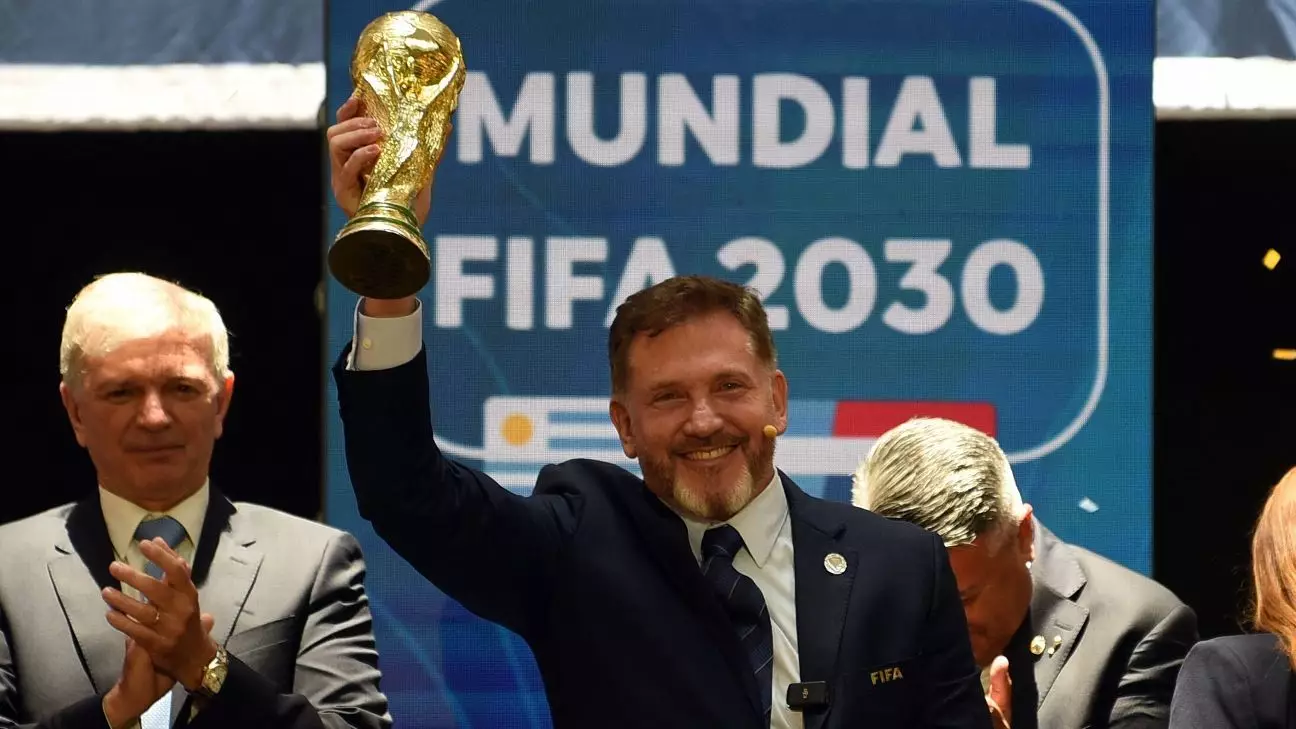
Alejandro Domínguez, the president of CONMEBOL, has ignited a passionate debate in the soccer world with his bold suggestion to expand the men’s 2030 World Cup from 32 to an unprecedented 64 teams. This radical proposal was formally introduced during a recent gathering at CONMEBOL’s 80th Ordinary Congress, reflecting a vision that transcends traditional boundaries and aims to celebrate a century of competition in a truly global context. At the heart of Domínguez’s argument is not merely the quantity of teams but the enrichment of the spectacle itself—a desire to ensure that this centennial tournament is an inclusive celebration where every nation has the chance to participate and showcase their talents.
A Nod to History: Uruguay’s Role as a Host
Uruguay, the birthplace of the World Cup in 1930, occupies a special place in this narrative. The nation is slated to host a game in this elaborate tapestry that includes five other co-hosts: Argentina, Paraguay, Spain, Portugal, and Morocco. Domínguez evokes the historical significance of this shared celebration, asserting that such a milestone deserves an enlarged participation that mirrors the diversity of the sport itself. Expanding the event to 64 teams is not just about the games; it symbolizes a commitment to inclusivity and global representation, providing every corner of the footballing world an opportunity to step into the spotlight.
Challenging the Status Quo: Public Reactions
The reaction to Domínguez’s proposal has been a mixed bag. On one hand, the notion of a World Cup with broader representation resonates with fans eager to see nations like Venezuela, which has yet to qualify for a World Cup, finally get their chance to shine. On the other hand, prominent voices in the football community, such as UEFA president Aleksander Čeferin, have been critical. Describing the idea of a 64-team tournament as “a bad idea,” he argues that such an expansion could dilute the quality of play and undermine the integrity of the qualifying processes that many countries invest so much effort into.
The crux of the debate pivots on the delicate balance between inclusivity and excellence. Should the World Cup, a premier symbol of sporting prowess, prioritize sheer participation over the elevated standards that have come to define its legacy? Critics of the expanded format contend that the increased number of matches—potentially swelling to 128 games—may compromise the high-stakes drama that fans have come to cherish.
Harmonizing Tradition with Innovation
The challenge that lies ahead involves reconciling these diverging perspectives. Domínguez’s vision is undoubtedly ambitious, calling for a festival-like atmosphere where no nation’s footballing culture is sidelined. If executed well, a 64-team World Cup could serve as a transformative moment for soccer, illuminating the talents of emerging nations while enhancing the global narrative of the sport. Yet, striking a chord that resonates with traditionalists and modernists alike will require thoughtful deliberation and an iterative approach to tournament structure.
As FIFA considers this proposal, there lies a potential for innovation within the cherished traditions of football. The key may well be in crafting a format that not only accommodates an expanded pool of teams while maintaining competitive integrity but also ensures that the spirit of the World Cup remains vibrant and inspiring for future generations.