
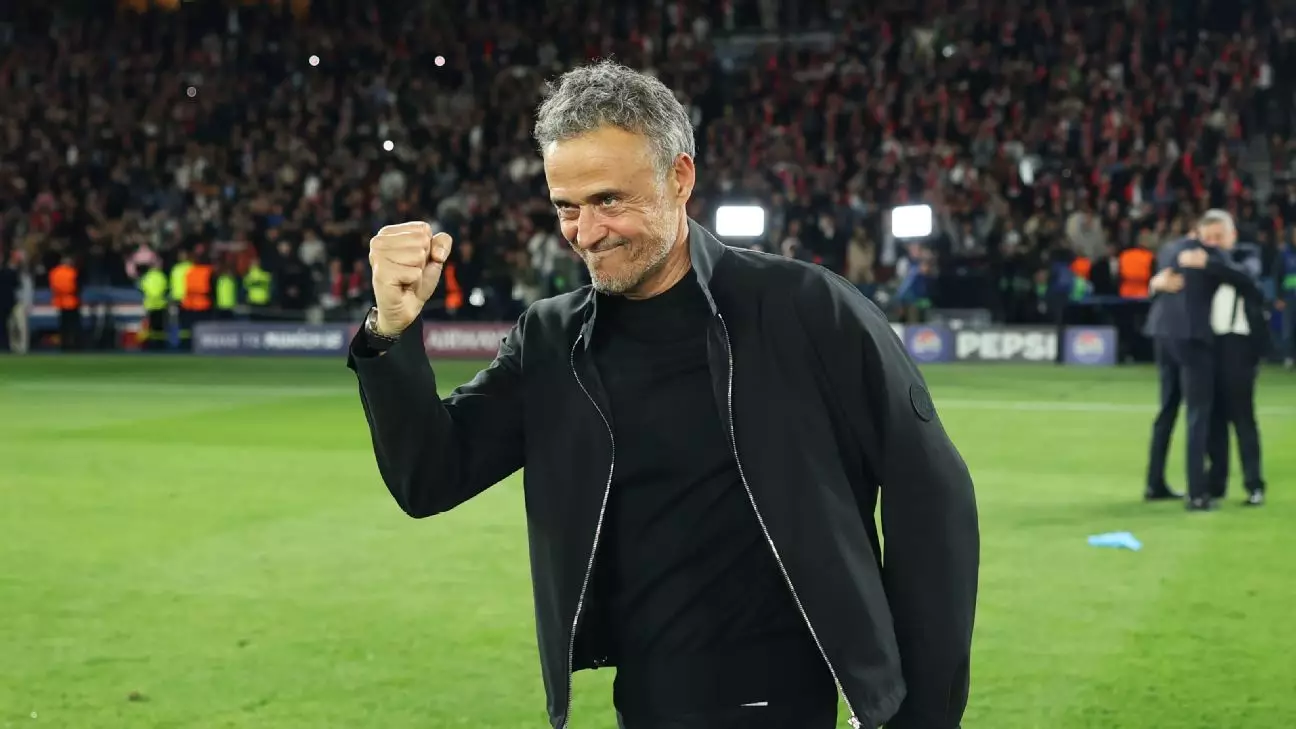
Luis Enrique, once the heart and soul of a magnificent era at Barcelona, now finds himself at the helm of Paris Saint-Germain (PSG), navigating the high seas of European football. As the Champions League final approaches, his relief at not facing his former team in this high-stakes match speaks volumes about the bond forged during years of triumph yet also reflects the complexities that come with personal and professional journeys in sport. The irony isn’t lost on me; after all, here’s a coach who celebrated monumental victories in Barcelona colors now positioning PSG for its own historic moment.
Luis Enrique’s acknowledgment of his mixed emotions about Barcelona’s exit from the competition showcases a remarkable mental agility. He articulated a sentiment that resonates with many who tread the delicate line between loyalty and ambition—a desire for his ex-club to flourish even while he climbs the new mountain of success with PSG. This emotional flexibility is vital in coaching, where decisions are often scrutinized through the lens of attachment and performance.
Turning the Tide with Underestimated Youth
PSG’s recent journey under Luis Enrique has not just been about avoiding the shadow of Barcelona; it’s also been a mission to build a team that defies expectations. After the departure of star player Kylian Mbappé to Real Madrid, many might have perceived the club’s prospects as bleak. Instead, Enrique has embraced the opportunity to cultivate a new generation of talent, crafting a squad that could be described as youthful dynamism interwoven with strategic depth.
In his second season with PSG, Enrique distills his approach to balancing experience with fresh talent. There’s a magic that happens when seasoned players mentor rising stars, and that chemistry is something he seems to be nurturing effectively in the squad. Offering opportunities to these younger players not only reinforces a belief in their capabilities but also creates an environment where ambition flourishes. Such a progressive mindset not only boosts morale within the squad but also positions the team as a force to be reckoned with on the European stage.
The Euphoria of Potential Success
As PSG prepares for their second-ever Champions League final, the stakes are undeniably high. The haunting memory of their 2020 loss to Bayern Munich in the final hangs in the air like a bitter reminder that glory is fragile. Yet, for Luis Enrique, the thrill of potential success—especially in the face of adversity—injects a palpable energy into his mission. Winning this trophy would not only afford the club its first European title but elevate Enrique’s status among the managerial elite, further bolstering his legacy.
Pushing through the psychological barriers that come with past failures requires a blend of tactical prowess and emotional intelligence. Maintained composure during intense games can often spell the difference between triumph and tragedy. The narrative surrounding PSG now echoes with the promise of redemption and the quest for greatness, a narrative that Luis Enrique seems determined to script in his favor.
Strategic Preparations and Tactical Shifts
The tactical preparations heading into the final against Inter Milan are also significant. Enrique’s ability to navigate varied tactical terrains has been evident, and his responsibility now hinges on ensuring that his players are not just physically fit but also mentally equipped to rise to the occasion. In football, the psychological aspect can often dictate outcomes, and history has shown that underestimating an opponent is a pitfall that no manager can afford.
His introspective discussions post-semi-final yield another layer of complexity into his strategy. Echoing sentiments regarding performance under duress, he expressed shock over Barcelona’s departure after scoring six goals in a semifinal. Such insights highlight the unpredictability that characterizes football and illustrate the unpredictability Enrique must prepare for against a resilient Inter Milan squad.
The task at hand is not merely about assembling a group of talented individuals; it’s about creating a cohesive unit that functions seamlessly under pressure. Luis Enrique is evidently aware of this challenge, and his experiences with diverse teams throughout his coaching career can only serve to inform his approach.
Embracing the Future
Luis Enrique’s journey with PSG showcases a passionate endeavor toward evolving a club’s identity beyond its legacy. While staring at the potential for treble glories—having already claimed Ligue 1 and eyeing victory in the Coupe de France—one cannot overlook the vibrant future he has set in motion.
Within the framework he’s established, the essence of the game is not simply about trophies but about growth—of players, of teams, and of dreams. The focus on nurturing talent highlights a thrilling phase in the identity of PSG, setting the stage for the club to transform into a European powerhouse. In this tale of ambition and renewal, Luis Enrique stands not just as a captain charting the course but as a visionary eager to etch his dream upon the canvas of history.