
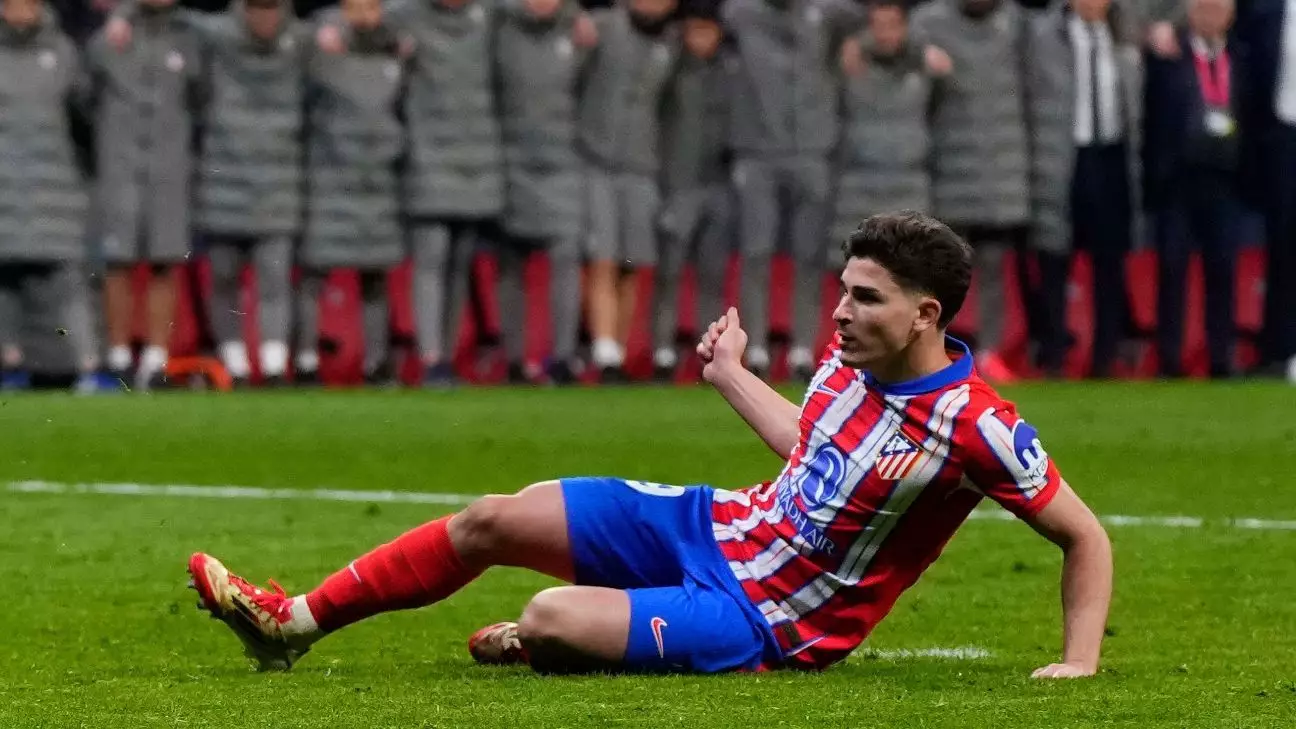
The world of soccer is no stranger to controversy, but recent developments surrounding the penalty kick laws have sparked renewed debate among fans, players, and officials alike. Following Julián Álvarez’s accidental double touch that eliminated Atlético Madrid from the Champions League, FIFA and the International Football Association Board (IFAB) have sought to clarify rules that, until now, seemed ambiguous at best. This decision is not just about a rule adjustment; it’s about the integrity of the game and the fairness with which it is administered.
A Misstep That Reshaped Regulations
In March, during a tense shootout against Real Madrid, Álvarez’s unfortunate slip led to what many considered an unjust disallowance of a goal that had crossed the line. The incident has revealed a critical gap in the current rulebook, prompting IFAB to revisit Law 14, which pertains to penalty kicks. The clearly stated intention is to ensure that rulings are made with a level of discretion that recognizes human error—whether from players or officials. Football is a game that thrives on emotional stakes, and decisions like these can cloud the spirit of fair competition, igniting frustration among teams and supporters.
Impact of the New Rules and Future Implications
Starting from the Nations League semifinal, the updated regulation stipulates that if a penalty kick results in an accidental double touch, it should be retaken if successfully scored. This clarification is crucial—it not only acknowledges the human element of the sport but also ensures that teams are not penalized for mere mishaps. However, if the double touch occurs and the penalty is missed, the attempt will simply be marked as such, with no opportunity for re-attempt, allowing the defending team to capitalize on the situation.
Furthermore, as we approach tournaments like the Club World Cup, which is set to take place in the United States in June, the implications of these changes could be profound. With more teams on the international stage, we may witness how these clarified rules affect high-stakes matches and whether they inspire a ripple of fairness or provoke further critiques of officiating inconsistencies.
Challenging the Status Quo
This adjustment opens up broader discussions about how soccer’s governing bodies need to approach the evolving nature of the game. Critics argue that while clarifications are welcomed, they also point to a persistent degree of inconsistency in interpreting and enforcing the laws of the game. The ongoing evolution of the rules begs for an open forum where stakeholders, including players and coaches, actively contribute to shaping regulations that foster fairness.
The impulse to refine these often-complex laws reflects a commitment to enhancing the game’s integrity, yet it also raises questions about whether the current structure for implementing these changes is conducive to timely and meaningful reform.
With every clarification, the hope remains that football can navigate these complexities while still serving its core philosophy: the pursuit of excellence on the pitch should always outweigh the mechanics of compliance.