
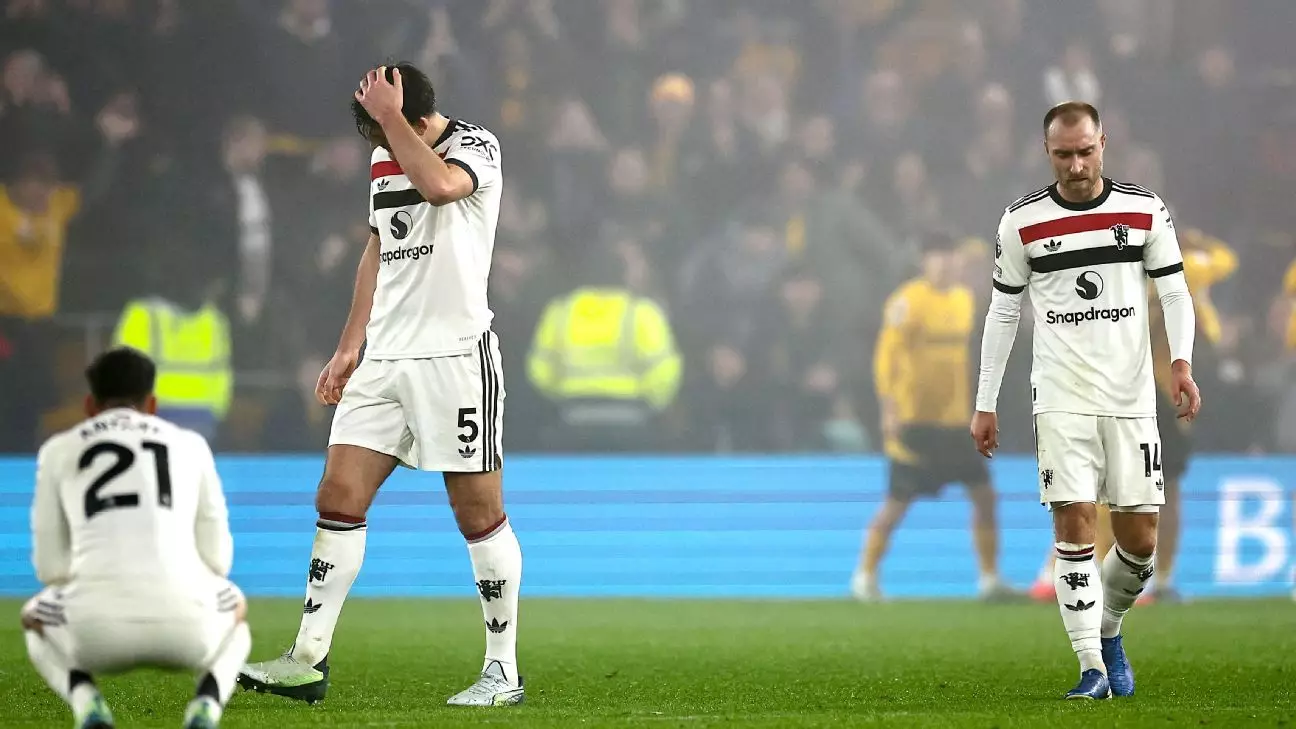
Manchester United has found itself in choppy waters, experiencing an alarming three-game losing streak following their 2-0 defeat against Wolves. This latest setback has raised concerns not merely about the results but also about the overall strategic direction under the stewardship of manager Ruben Amorim, who has now guided the team to only two victories in eight Premier League outings. The alarming reduction in effectiveness suggests that a deeper examination of both tactics and player mentality is essential for reversing the current trend.
The clash against Wolves provided pivotal moments that highlighted critical flaws in United’s gameplay. Captain Bruno Fernandes’s dismissal just two minutes after the second half commenced sent shockwaves through the team, reducing their attacking threat significantly. The subsequent goal by Matheus Cunha, which came straight from a corner, reflects a disturbing lack of defensive organization that has haunted the team throughout the season. When Hwang Hee-Chan sealed the victory for Wolves in the dying moments, it compounded the sense of helplessness that has started to characterize United’s performances.
Amorim’s reflections post-match revealed an awareness of these struggles. The call for increased aggression indicates a recognition that the players need to adopt a more fierce and relentless approach on the pitch. However, the assertion that training time has been compromised is troubling; without proper preparation and practice, aggressive instincts cannot be cultivated.
The metrics paint a grim picture for Amorim’s regime, with only four wins across all competitions since his appointment. According to ESPN Global Research, this trio of consecutive losses in all competitions marks the first such instance since September 2023, emphasizing the severity of the situation. Critics will question whether Amorim’s tactical philosophy is aligned with what is needed to foster success at a club of United’s stature. This severity must now become a catalyst for change; the current trajectory is untenable if the club is to reclaim its former standing in English football.
What is clear is that a fundamental revamping of both tactical approaches and team dynamics is necessary. Amorim has alluded to the need to enhance interpersonal relationships within the squad. Improved synergy among players not only boosts on-field communication but also cultivates a winning mentality. The manager must prioritize instilling resilience and a robust fighting spirit, becoming more proactive in training sessions to enhance the aggressiveness that he rightly identifies as lacking.
United can no longer afford to keep operating without a clear plan. A united front, built on both coordination and the drive to perform, is essential for steering the club out of this turbulent phase. As the team prepares for upcoming fixtures, it will be crucial for Amorim to strike a balance between tactical instruction and fostering an environment where players feel motivated to push beyond their current limitations. Failure to address these issues may see Manchester United’s descent continue, much to the dismay of its passionate fanbase.