
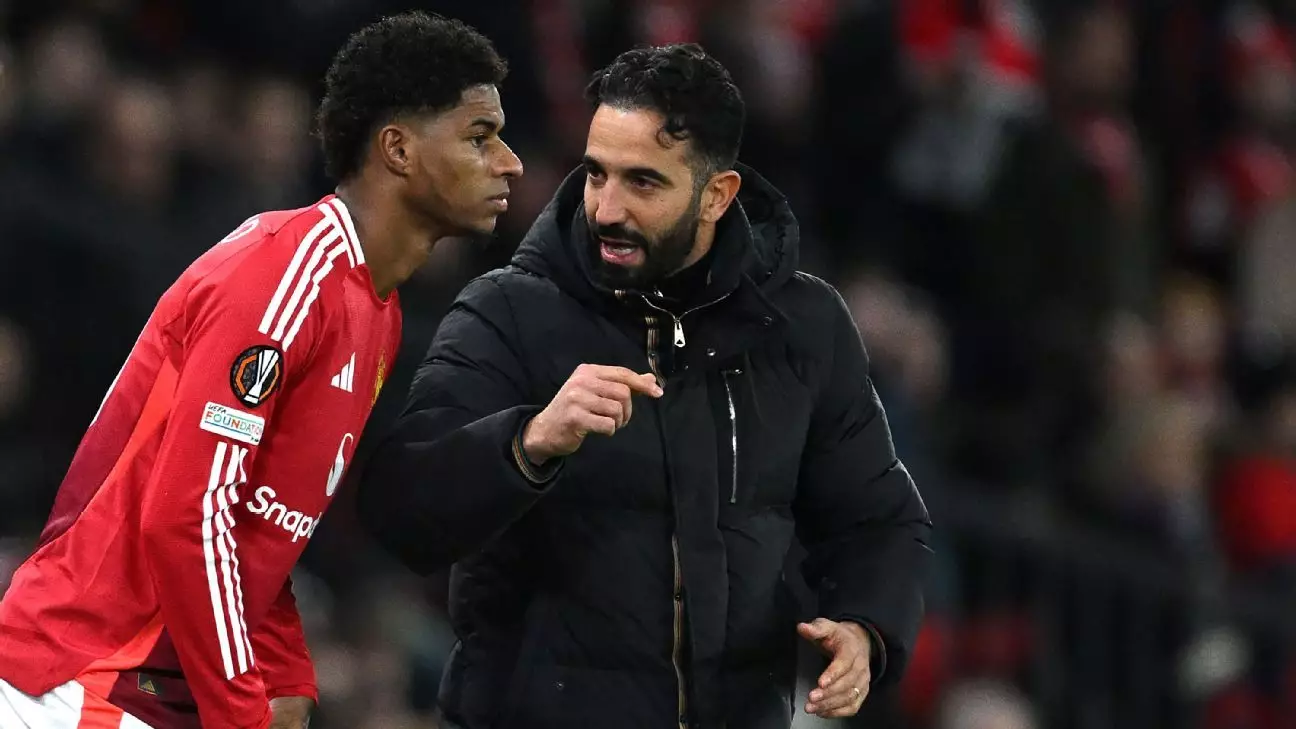
In the intricate world of football, player loyalty often clashes with personal ambition, and the case of Marcus Rashford epitomizes this struggle vividly. Rashford, a product of Manchester United’s academy, has spent two decades with the club, carrying the hopes of a generation that has watched him grow from a promising youth talent into a celebrated forward. However, the current chapter of his career is laden with uncertainty, as he hints at a desire for new challenges outside of Old Trafford. This situation raises a critical question: how can a club balance the aspirations of a player who has been a loyal servant versus the pressing demands of a competitive landscape?
Ruben Amorim, the new manager at Manchester United, finds himself at the helm during a tumultuous period. His public declaration that he wants Rashford to remain in Manchester indicates a clear understanding of the dynamics of football management. Amorim sees Rashford not only as a talented player but also as an emblem of potential redemption for a club desperate to reclaim its stature in European football. “We have here a new challenge,” he asserted, hinting at the daunting task ahead of rebuilding a squad that has faltered on numerous fronts. Amorim’s confidence in Rashford stems from his belief that the true challenges and rewards lie within the club, not outside it.
The recent decision to bench Rashford during the Manchester derby against City was a pivotal moment, signaling a shift in the manager’s strategy. Rashford himself described the experience as “disheartening,” and his subsequent comments about seeking a new adventure illustrate the internal conflict he faces. While one might argue that a break could reignite his passion, it simultaneously casts a shadow over his commitment to the club during challenging times. The emotional toll of such moments can often sway a player’s decision-making, leading them to contemplate options that they may not have considered previously.
Despite these challenges, there remains an opportunity for reconciliation. Amorim’s approach to training and player development is fundamental in nurturing Rashford’s potential. The manager’s insistence on demanding the best from every player could foster an environment where Rashford feels valued and understood. By focusing on rehabilitation and enhancement rather than mere performance metrics, the coaching staff can instill confidence back into a player who has, at times, struggled under pressure.
The Bigger Picture of a Club in Transition
As Manchester United continues to navigate the unpredictable waters of modern football, the case of Marcus Rashford represents a microcosm of larger systemic issues facing the club. The challenge lies not just in talent acquisition but in retaining homegrown players who have a deep connection to the club’s ethos and history. Rashford’s potential departure would not just affect the squad’s dynamics; it could symbolize a larger loss of identity for a club aiming to restore its former glory. As the managerial era of Amorim unfolds, the focus will undoubtedly be on synthesizing ambition with loyalty, creating a united front that can face the future head-on.