
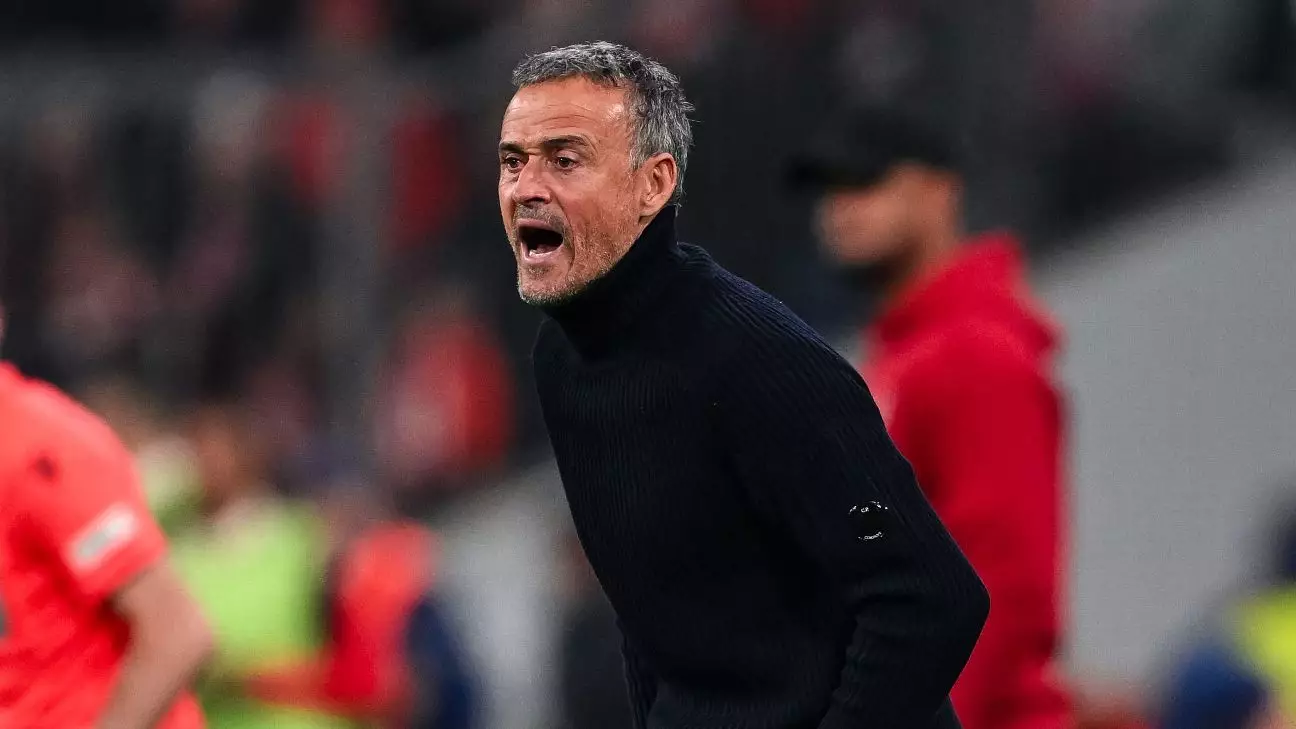
Paris Saint-Germain (PSG) finds itself amidst a turbulent period, following a narrow 1-0 defeat against Bayern Munich in the Champions League. The team’s performance has drawn significant scrutiny, particularly due to the sending off of star player Ousmane Dembélé, who was shown a red card in the 58th minute. This loss marked yet another disappointment for the French giants, who have only managed to secure a single win in their last four Champions League fixtures. Following this disheartening game, head coach Luis Enrique did not shy away from shouldering the blame, passionately stating, “if there is anyone to blame, it is me.”
Luis Enrique’s candid admission of responsibility stands out in an era where many coaches might deflect criticism onto their players or external factors. His assertion that the “responsibility is always global” implies a deep-seated understanding of his role in both victories and losses. By declaring himself the culprit, he not only emphasizes the importance of leadership but also elevates the accountability expected from a head coach in such high-stakes environments. This acknowledgment can be interpreted as a double-edged sword. While it exhibits humility, it also raises questions about his tactical decisions and preparedness in crucial matches.
PSG’s current form in the Champions League has been far from ideal. With only one point gleaned from a possible twelve in recent encounters, the situation is alarming for a club of PSG’s stature. This inconsistency raises concerns not only about the players’ performances but also about how effectively the coaching staff can manage a roster filled with talent. Enrique’s comments suggest that the recent losses have provided critical insights regarding player capabilities and long-term viability within the squad. It highlights the precarious nature of football, where a few poor performances can lead to significant changes in a club’s roster.
Despite currently leading Ligue 1, the burden of recent failures in Europe weighs heavily on the team and its supporters. Enrique described the situation as “very frustrating,” especially after experiencing a loss at home, which is traditionally seen as a fortress for PSG. The psychological impact of such defeats can be profound; they not only affect the players on the field but also the administrative dynamics and fan morale. The challenge for Enrique now is to transform this frustration into motivation, ensuring the team remains focused and determined in their remaining fixtures.
As PSG navigates through this troubling phase, Luis Enrique’s approach—marked by transparency and ownership—will be critical in defining their trajectory for the remainder of the season. While he has accepted the burden of blame, the reactions and adjustments from both the coaching staff and players will ultimately determine whether PSG can rally from this adversity. With three matches left to secure a favorable outcome in the Champions League, the time for reflection is now, but action must follow swiftly to avert further disappointment. The coming weeks will be crucial in determining if PSG can convert this period of introspection into a resurgence on the pitch.