
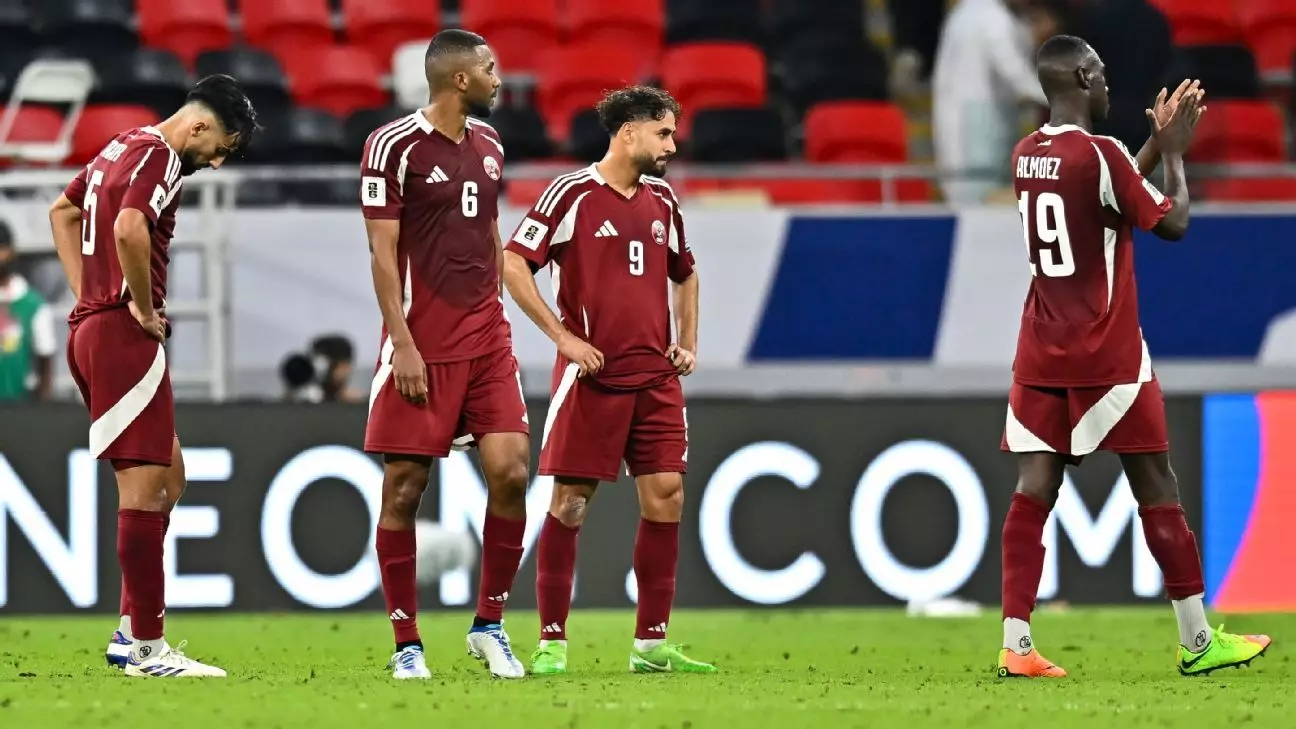
Just a year after hosting the FIFA World Cup, Qatar finds itself in a precarious situation as it attempts to qualify for the next tournament in 2026. Initially buoyed by their recent achievements, including back-to-back wins in the AFC Asian Cup in 2019 and 2023, the team was expected to capitalize on an expanded World Cup tournament that now allows 48 teams. This transition seems to offer Qatar a golden opportunity to secure its spot on football’s grandest stage through merit. However, the harsh reality is that their campaign has so far failed to meet heightened expectations, leaving them languishing in a disappointing fourth position within a meticulously competitive Asian qualifying group.
Analyzing Qatar’s Group A performance reveals a sobering truth; with only two wins in their first six matches, the host nation has accumulated a paltry seven points. This dire statistic sees them trailing their rivals, notably the United Arab Emirates (UAE) and Uzbekistan, both of whom have proven to be formidable opponents. Qatar’s defensive woes have caught attention as well; they currently own the worst defensive record among all competing Asian teams, having conceded 17 goals. A particularly humiliating 5-0 defeat to the UAE served as a wake-up call, tarnishing the nation’s football reputation. They are now faced with a daunting task of mustering enough momentum to secure at least a fourth-place finish, which would keep their World Cup dreams alive.
A critical point of examination is the tactical approach under head coach Tintín Márquez. While he played a vital role in guiding Qatar to Asian Cup glory, his ensuing strategies have yielded mixed results. The team has attempted various formations, oscillating through a 5-3-2 against Uzbekistan, a 4-3-3 against the UAE, and even an old-school 4-4-2, leading to uncertainty among players regarding their roles on the pitch. This inconsistency may have impeded the team’s ability to develop a coherent strategy, which is essential for success at the international level. Moreover, Márquez’s reliance on older players such as Boualem Khoukhi and Abdulaziz Hatem, while they have experience, raises questions about long-term sustainability and adaptability.
Despite the reliance on veterans, Qatar’s squad does feature a core of youthful talent. Akram Afif and Almoez Ali, both 28 years old and early career standouts, highlight the balance between experienced leadership and the infusion of youth. Moreover, emerging talents like the 19-year-old Ibrahim Al-Hassan could become the backbone of Qatar’s future competitiveness. The question remains, however, whether this transition is being managed effectively. With players like Afif acquiring the captain’s armband from the long-serving Hassan Al-Haydos, the team must navigate a delicate leadership shift. Afif’s leadership style contrasts significantly, as he inspires primarily through skill rather than vocal authority, raising questions about the team’s emotional and psychological cohesion.
The overarching concern is that Qatar’s football hierarchy seems overly focused on immediate results at the expense of long-term development. This attitude is particularly evident in their hesitance to pursue naturalization routes for foreign-born players, an avenue that some of their continental rivals have successfully leveraged. Although incorporating a select few naturalized citizens into the squad could enhance competitiveness, Qatar has remained committed to nurturing its homegrown talent. Balancing this commitment with the urgent need for World Cup qualification remains an ongoing challenge.
As Qatar grapples with its current predicament in World Cup qualifying, the looming prospect of extending their journey in international football rests on how effectively they can leverage both their experienced personnel and budding young stars. The clock ticks ominously with only four matches remaining, and the weight of expectation continues to hang heavily. For Qatar to overcome their recent struggles, it will require decisive action and a clear understanding of their strategic goals moving forward. Not only must they aim for immediate results, but also establish a robust framework that cultivates the next generation of talent while learning from the missteps of the past. The road ahead may be fraught with challenges, but the prize—qualification for the World Cup—remains tantalizingly within reach.