
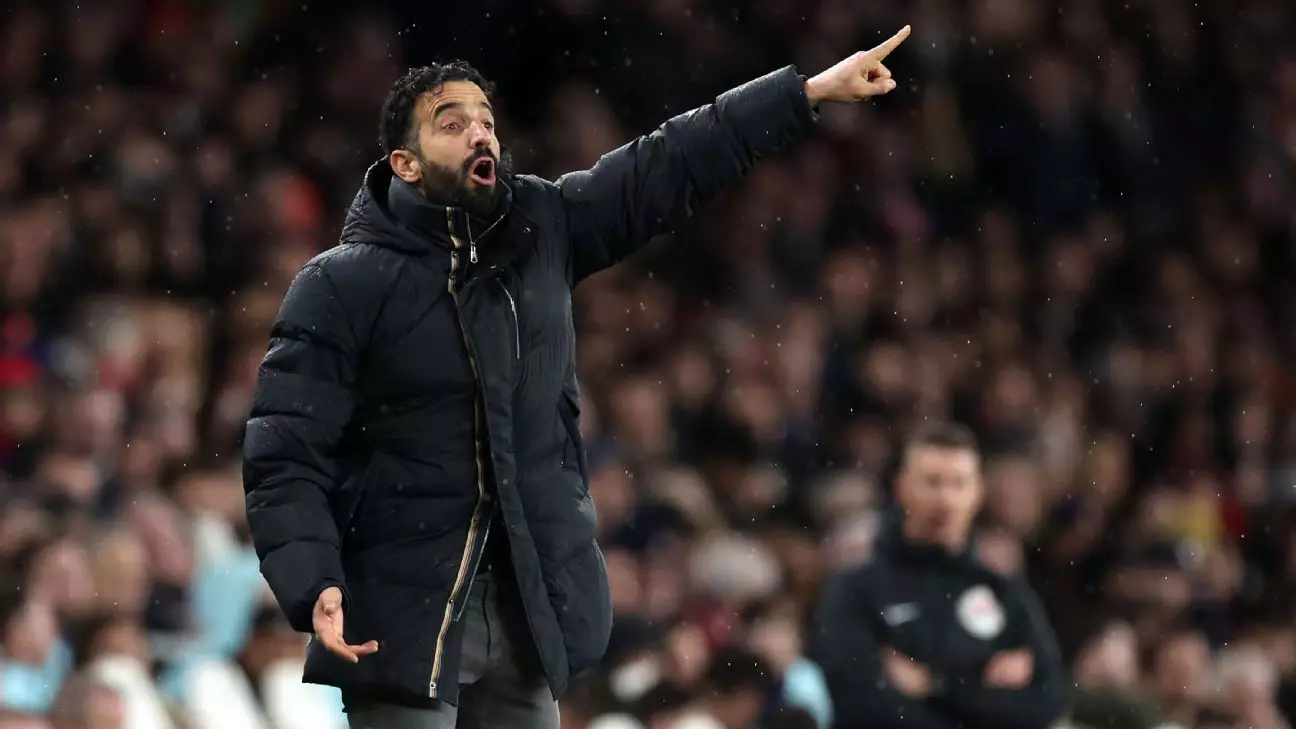
Ruben Amorim has stepped into a role at Manchester United that many may view as daunting, stating that he has inherited a “difficult position.” This awareness of the challenges at hand is crucial as he navigates the expectations incumbent upon managing one of football’s most revered clubs. Despite boasting an impressive legacy—20 English top-flight titles—United has struggled to maintain this status over the past decade. The failing results on the pitch juxtaposed with the illustrious history encapsulate the paradox that the current squad faces.
In a stark admission, Amorim characterized his new club as “a massive club but not a massive team,” shining a light on the gap between historical successes and present-day performance. This is a candid acknowledgment that places a significant emphasis on the need for realistic aspirations despite United’s robust heritage. As the team currently finds itself floundering in the bottom half of the Premier League standings, behind even lower-tier competition such as Nottingham Forest, Amorim’s recognition of the situation presents both a challenge and an opportunity for holistic improvement.
The Portuguese manager understands that revitalization won’t happen overnight. With limited time to imprint his methods onto the team due to a congested fixture schedule, Amorim is prioritizing effort over tactical sophistication. His repeated assertion that players must “run like mad dogs” illustrates a fundamental principle of his coaching philosophy. It underlines the notion that without a high work rate, even the most technically gifted players will struggle to find success. His approach indicates that hard work and determination are the building blocks for the tactical overhaul he envisions.
Amorim’s focus on the psychological aspect of running and effort highlights a critical component often overlooked in the world of football management. As he indicates, turning hard work into a mindset is integral to shifting the team’s trajectory. By stressing that mental fortitude must precede tactical considerations, he is laying the groundwork for a more resilient squad capable of adapting to the demands of top-tier football.
Despite the current turmoil, Amorim’s measured demeanor and realistic understanding of the club’s challenges instill a sense of hope. His approach to harnessing the club’s historic legacy while acknowledging the pressing need for growth reflects a balanced strategy, aiming not only to revitalise the team’s fortunes but also to nurture a renewed sense of identity. As he embarks on this journey at Old Trafford, the opportunity to marry Manchester United’s glorious past with a promising future rests heavily on his shoulders. In doing so, Amorim has the potential to redefine what it means to be a “massive club” in a league hungry for competitive success.