
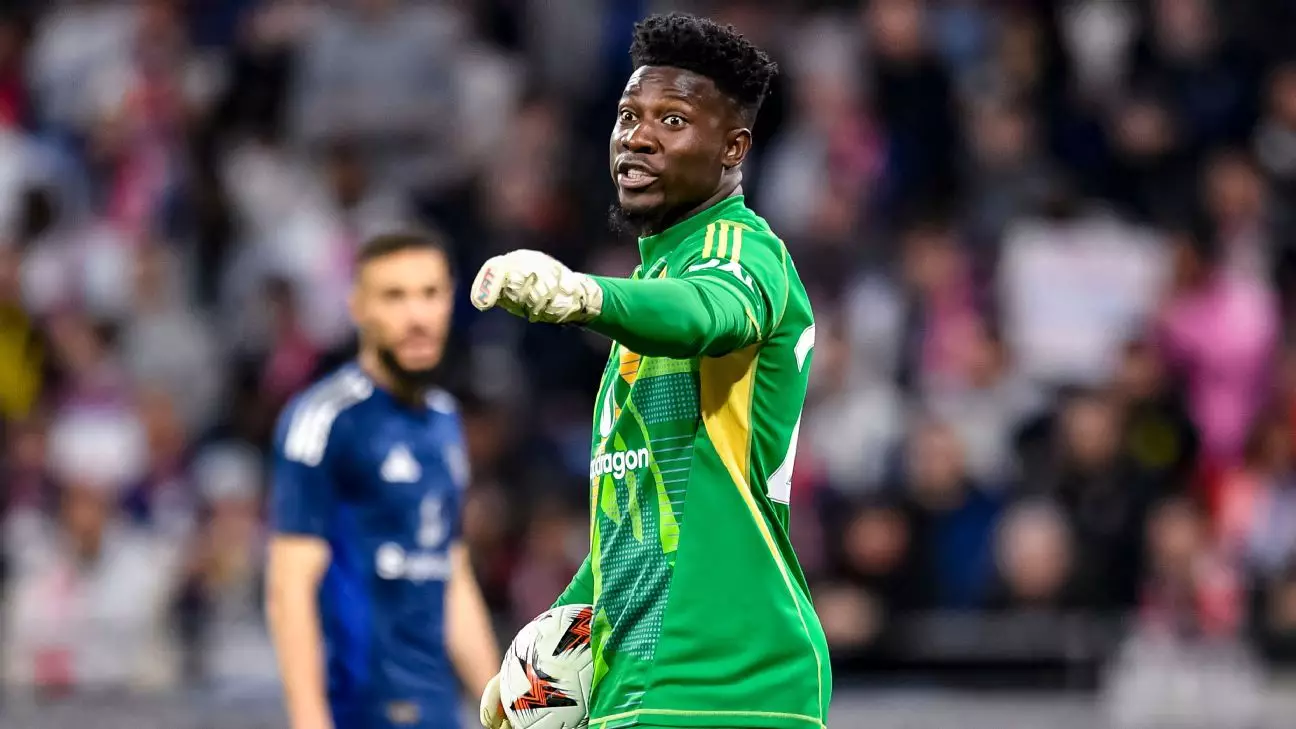
The UEFA Europa League quarterfinal first leg between Lyon and Manchester United unfolded in front of a highly charged crowd in Lyon, concluding with a tense 2-2 draw. The match was not merely a competition between two respected football clubs; it became a dramatization of individual errors and psychological warfare, most notably highlighted by André Onana’s striking blunders. Earlier in the week, Onana audaciously declared Manchester United as “way better” than their French rivals, yet his performance suggested a starkly different narrative. The stakes were high, and in the world of European football, such slip-ups can reverberate throughout a club’s season and morale.
The Fallout of Individual Errors
Onana’s catastrophic errors—especially his crucial mistake deep into stoppage time—were not only harmful to his team’s aspirations but also served to amplify an already increasing tension surrounding his role as United’s goalkeeper. These instances were more than just unfortunate; they were emblematic of a player struggling with confidence and form. Comments from Nemanja Matić, who was quick to critique Onana after a personal barb was thrown during the buildup to the match, only exacerbated the struggle. With a fire now trained on him, Onana needed to deliver. Instead, his downfall only ignited more discussions on whether he truly fits into United’s long-term plans.
It’s noteworthy that Onana’s situation resonates with fans and analysts alike; despite being an elite talent, he has become a lightning rod for criticism, particularly when the expectations are so staggeringly high for a club of Manchester United’s stature. Every mistake magnifies his previous missteps, as his personal battle with Matić became a microcosm of the larger battle on the pitch.
Lyon’s Psychological Advantage
Conversely, Lyon capitalized on United’s turmoil, seizing both moments of Onana’s slips to shift the psychological tide of the match. When Rayan Cherki equalized in stoppage time, it was more than just a goal; it was a rallying cry for Lyon and a signal that they could contest with a team that some fans consider to be the favorites in this tie. Lyon entered the match with a sense of determination that was palpably distinct. They took the fight to United and showed that they were not intimidated by the history or the reputation of their opponents.
The contrasting attitudes on the pitch demonstrated a double-edged sword of confidence and anxiety. While United showcased their penchant for control—largely dominating possession and producing several scoring opportunities—their inability to convert those chances ultimately wore them down, leaving them vulnerable to counterattacks.
Coaching Dynamics and Future Implications
For Ruben Amorim, the head coach of United, the night resonated with the mixed emotions often inherent in football management. He finds himself in a precarious position; defending his goalkeeper while attempting to salvage the morale of the squad is no mean feat. Amorim’s philosophical stance provided insight into the challenges he faces—he echoed sentiments of resilience, stating, “If you look at the season, I make more mistakes than them.” However, while such honesty can humanize a coach, athletes tread a delicate line between support and accountability.
As he observed the disappointment in the dressing room, one wonders whether the philosophical approach is enough to navigate through the mental maze of European football. The reality is that while players must perform, coaches need results, and any notion of “changing everything” for the second leg must be met with focused urgency. The relationship between coach and player places a crucial role in determining success or failure, and Amorim’s confidence in Onana may have to face a tactical reassessment should these mistakes continue.
The Road Ahead: A Complicated Journey for United
Heading into the second leg at Old Trafford, the undercurrents of tension are unmistakable. The question now stands: how can United rebound from a match laden with such blame? The pressures mount as fans will be expecting a decisive performance against Lyon, which may cascade into the season’s future. Additionally, with players like Rasmus Højlund showing potential but also inconsistency, the spotlight also shifts toward their ability to step up when it counts.
Ultimately, the clash in Lyon reminds football enthusiasts that while the game often glorifies moments of triumph, it is the missteps that frequently dictate a team’s fate. As such, it will take more than just talent on the field—it will require a collective resilience to navigate the fierce landscape of European competitions. Whether United can glean lessons from their encounter and rise to the occasion in the home leg remains a captivating narrative that will unfold in the days to come.