
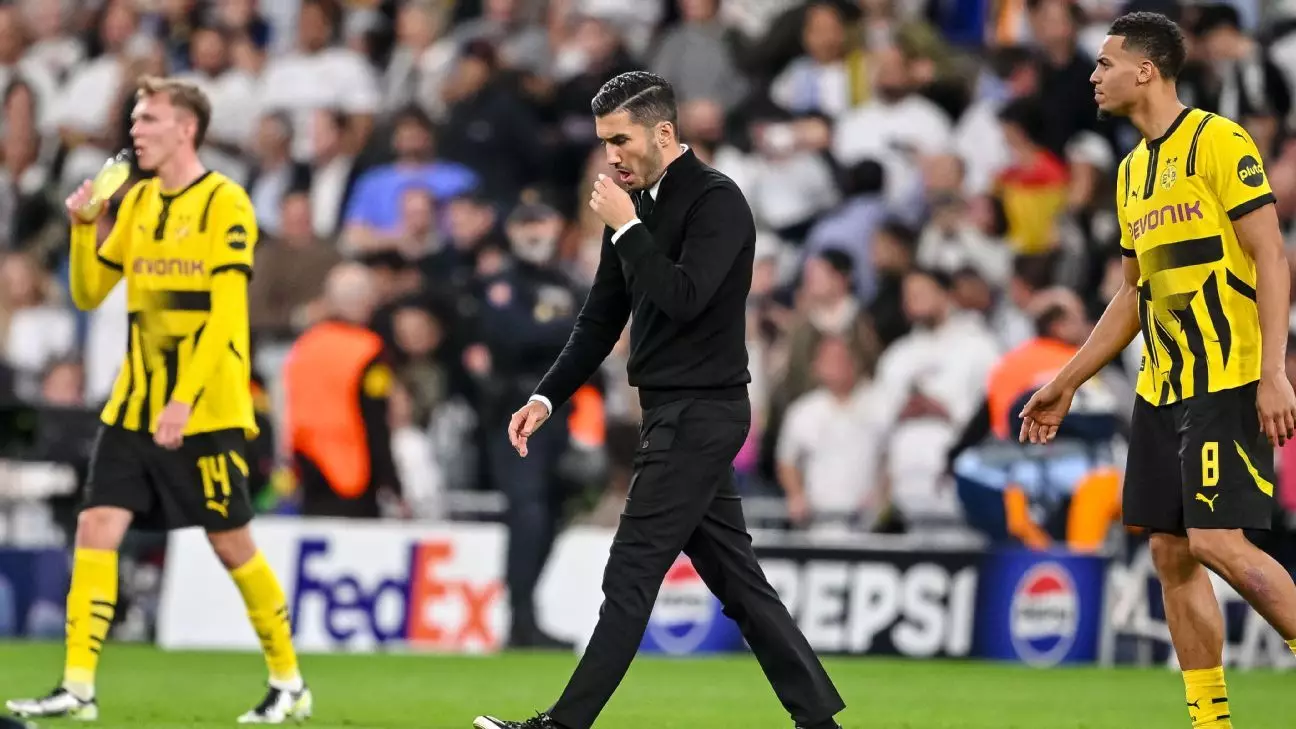
Borussia Dortmund’s recent Champions League outing against Real Madrid was more than just another defeat; it unveiled deeper issues plaguing the team. In this clash, which served as a painful reminder of their vulnerabilities, Dortmund’s performance highlighted the deficiencies that have emerged since their last experience on the grandest European stage. Far from merely an isolated incident, this match epitomizes the broader struggles of a club at a crossroads.
The encounter brought Dortmund’s aspirations crashing into reality, particularly acting as a reminder of their defeat in the UEFA Champions League final just a scant four months earlier. They faced familiar foes in Real Madrid, yet this time, the on-pitch narrative told a different story. Under the watchful eye of Nuri Şahin, who has succeeded Edin Terzic, the team appeared far removed from the competitive edge once associated with Borussia Dortmund. While Terzic’s tenure was marked by promise and youthful exuberance, Şahin’s leadership remains mired in transition, leaving fans to question not only the tactics but also the strategic direction of the club.
A significant talking point from the match was the tactical switch from the 4-2-3-1 formation, which dominated the first half, to a timid 5-4-1. As the game progressed, this alteration transformed Dortmund from potential victors to victims of Real Madrid’s relentless resolve. Şahin’s decision to replace an adventurous Jamie Gittens with Waldemar Anton suddenly shifted the team dynamics—a move perceived by many as an abandonment of their attacking intent. The vulnerability of the defensive line became evident as they crumbled under pressure from Madrid, leading to not just a loss but a debilitating loss of confidence.
Furthermore, the introduction of Emre Can, in a desperate attempt to find stability, forced him into an insurmountable matchup against Vinícius Júnior, which further underscored the tactical miscalculations made by the management. Such decisions raise pressing concerns about Şahin’s preparedness to navigate the complexities of high-stakes matches. With defensive frailties glaring, it’s imperative for him to recalibrate the team’s approach ahead of their fixtures in the Bundesliga.
Statistically, Borussia Dortmund revels in home comforts; however, their performances tell a contradictory story. Having been dominant at Signal Iduna Park, they nonetheless struggle on the road, with a continued streak of defeats that leaves supporters disillusioned. A recent match against St. Pauli illustrated the team’s propensity to stumble against inferior opposition when away from home. The eventual triumph, secured late, belied a lackluster showing that raises alarms about focus and mental fortitude.
As the team prepares for their impending encounter with FC Augsburg, the significance cannot be understated. It’s not merely about ratifying home dominance; the squad needs a psychological and tactical reset to restore confidence and cohesion.
The persistent issues plaguing Borussia Dortmund boil down to a fundamental lack of cohesion and foresight in their transfer strategies under newly appointed managing director of sport, Lars Ricken, and sporting director, Sebastian Kehl. Their approach needs recalibration to emulate the successful models seen in rival clubs like Bayer Leverkusen and Bayern Munich. The days of skillfully scouting young talent and nurturing it seem distant, as demonstrated by the threadbare squad, lacking depth and dynamism.
While BVB’s efforts to transition following the departures of stars like Erling Haaland and Jude Bellingham have been admirable, they have yet to yield the expected returns. A failure to recognize positional gaps leaves the squad frail and reactionary rather than proactive. Critics and fans alike remain skeptical about the current trajectory, with potential overhaul needed for long-term success.
When assessing the broader context of German football, Borussia Dortmund’s struggles become even more pronounced against the backdrop of their Bundesliga rivals. While Stuttgart celebrated a surprising victory against Juventus, Bayern’s high-risk strategies led to back-to-back defeats, highlighting their own defensive vulnerabilities. This tells a story of inconsistency across the board; however, teams like RB Leipzig and Bayer Leverkusen display a clearer vision, showcasing maturity in handling the rigors of European competitions.
The plight of VfL Bochum, sitting at the bottom of the league, illustrates the pressure within the Bundesliga—they face a shake-up after dismissing their coach and sporting director. This turbulence echoes the necessity for Dortmund to find stability and identity amidst league-wide challenges.
In light of recent performances, Dortmund need a profound reassessment of their approach both on and off the pitch. As they aim to reclaim past glories, a unified strategy, focusing on tactical soundness and nurturing homegrown talent, is critical. Fans await a resurgence that will enable the club to draw inspiration from their illustrious history while charting a progressive path for future successes. In the face of a tumultuous season, reflection, reinvention, and resilience will determine if Borussia Dortmund can muster the strength to rise again.