
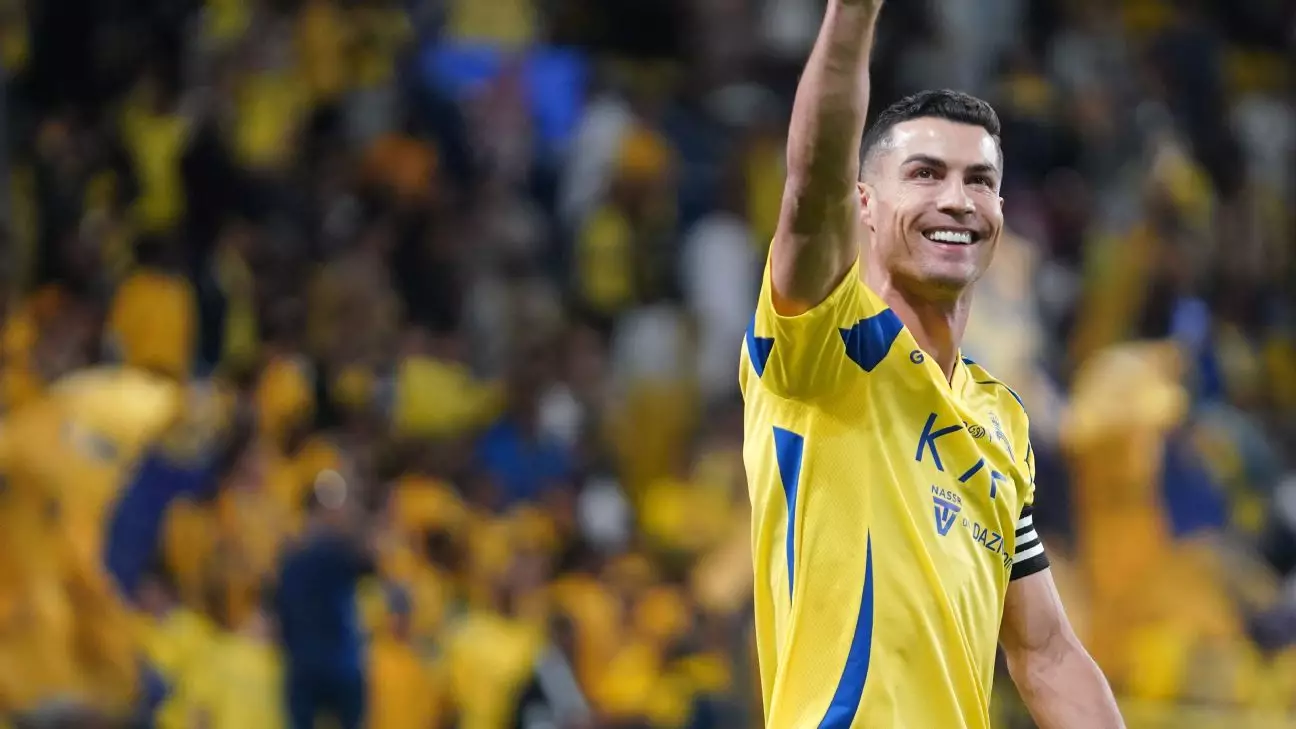
Manchester United, a name synonymous with football glory, has faced its fair share of turbulence in recent seasons. The club’s struggles have continued even under new management, raising important questions about the deeper issues at play behind the scenes. Recent remarks by Cristiano Ronaldo, once a star player for the Red Devils, shine a light on these complexities and paint a larger picture of the challenges facing one of the world’s most famous clubs.
Ruben Amorim, the current manager of Manchester United, has endured a rocky start, with only five victories out of ten matches since taking over. The grim statistic of having lost four of the last five Premier League encounters has led to speculation about his job security. Yet, Ronaldo, now plying his trade in Saudi Arabia with Al Nassr, has been vocal in asserting that Amorim’s struggles are not merely indicative of his managerial capabilities. At the Globe Soccer Awards, he emphasized that the depth of the problems at Manchester United extends far beyond the tactical decisions of a coach.
Ronaldo’s metaphor of an “aquarium” provides a vivid analogy; it indicates that the issues plaguing the club are systemic rather than isolated. He implies that merely changing the personnel at the helm—be it a coach or other management—will not, in itself, rectify the underlying dysfunctions present at the club. Instead, he suggests that a more substantial overhaul is necessary, calling for a clearer strategic vision and the identification of key structural flaws.
One of Ronaldo’s striking comments concerns the ownership model at Manchester United. His critique of the Glazer family’s stewardship—one he has maintained over several years—underscores a growing frustration with the way the club is run. He believes that a change in ownership might be the catalyst required to navigate the club back to success, something he alluded to when he teased the possibility of someday owning a major football club.
Ronaldo’s journey since his departure from Manchester United has been marked by reflections on his time at the club, describing it as a place he still holds dear. Yet, his calls for accountability resonate not just with fans but also with analysts and pundits who have, over the years, scrutinized the Glazers’ commitment to the team. The question remains: can Manchester United truly reclaim its status as a football powerhouse under the current ownership?
While discussing the nuances of competing in the Premier League, Ronaldo pointed out the heightened level of competition in the English top flight. His assertion that “there are no easy games anymore” reflects an era of unpredictability in football, where even minor teams can challenge the historical giants. This transformation calls into question the expectations for managers like Amorim, who, despite his remarkable credentials in Portugal, may find the challenges of English football daunting.
The inherent difficulties involved in adjusting to this competitive landscape cannot be underestimated. Every match now requires tactical versatility, and the pressure to achieve results is unlike any other league, further complicating the equation for burgeoning managers.
Amid the chaos and criticism, Cristiano Ronaldo’s hope for Manchester United shines through. His message is clear: there is potential for recovery, but it may take time. While expressing confidence in Amorim’s capabilities, he acknowledges the daunting nature of the task ahead, suggesting that success requires patience and resilience from all quarters involved with the club.
As fans ardently wish for a return to glory days under the iconic red jersey, Ronaldo’s insights serve as a reminder that the solution to Manchester United’s woes lies far deeper than the pitch. It requires a holistic approach—one that involves management, ownership, and most critically, a commitment to nurturing a club culture that honors its storied past while adapting to modern football’s intricate demands.
As the story of Manchester United continues to unfold, the determination expressed by Ronaldo leaves both fans and critics curious: will the sun rise on a new era for their beloved club? Time will tell, but for now, hope remains alive, rooted in the very fabric of what Manchester United represents in the world of football.