
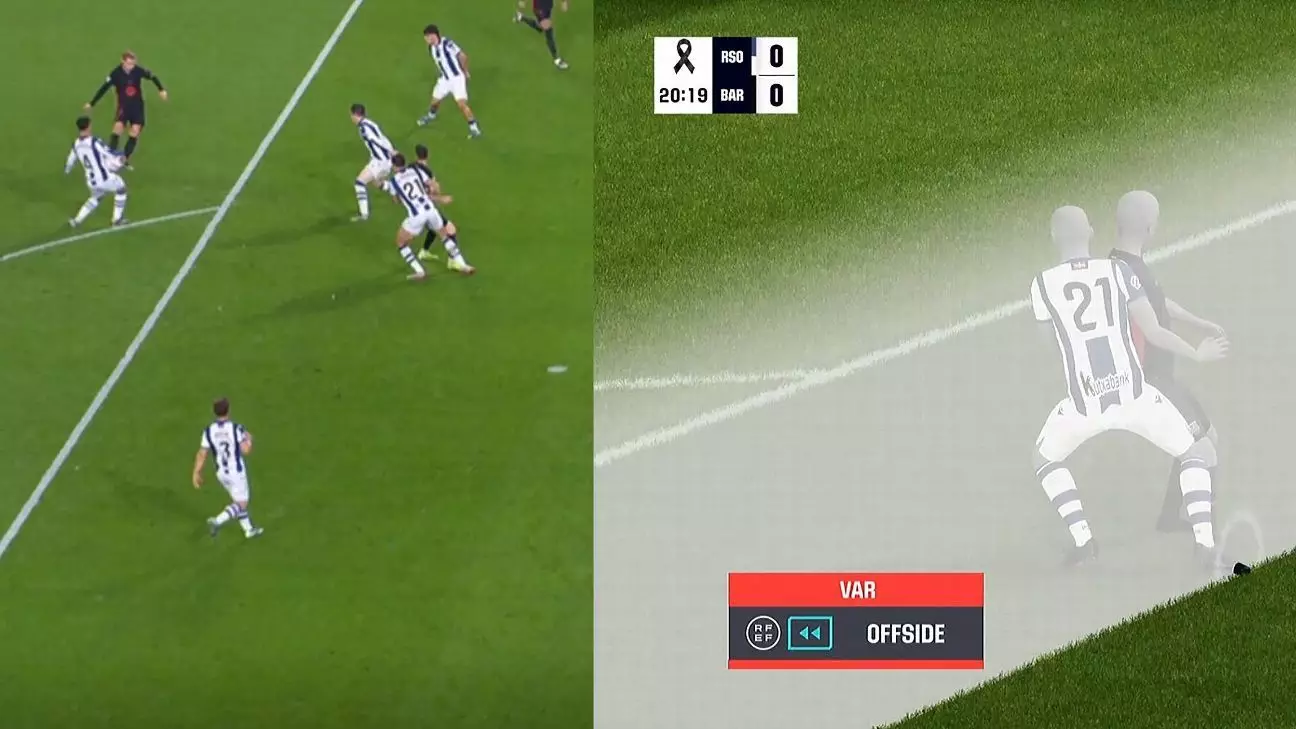
In a tightly contested match against Real Sociedad, FC Barcelona’s Robert Lewandowski had a goal disallowed due to a contentious decision made by the semi-automatic VAR (SAOT) technology. The disqualification of Lewandowski’s strike, which occurred in the 14th minute, left the team and its supporters agitated, especially since it was closely linked to the outcome of the match, ultimately resulting in a 1-0 defeat for Barcelona. Deco, the sporting director of Barcelona, has publicly voiced the necessity for a comprehensive explanation regarding the decision-making process that led to the goal being ruled out.
Deco’s comments reflect a broader dissatisfaction with the implementation of VAR technology in football, aimed at enhancing the accuracy of officiating. He raised pertinent questions about the reliability of the semi-automatic system, expressing confusion about its function. “If it’s semi-automatic, why isn’t it fully automated?” Deco wondered aloud, highlighting the inconsistencies that still plague the technology. Critics like Deco argue that the introduction of VAR was meant to alleviate doubts surrounding contentious calls. However, as most football fans have witnessed, the technology has not entirely dispelled controversy—instead, it sometimes seems to exacerbate it.
Deco’s stance serves as a reminder that inconsistency can undermine the sport’s integrity. The challenge presents itself when a technology designed to reduce human error inadvertently falls prey to subjective interpretation. The question, therefore, arises: is the footballing community prepared to trust a system that it does not fully understand? Deco’s call for clarity signals a collective demand from clubs and fans alike for a more transparent explanation of how offside calls are made. “Where did the error occur?” he questioned, insisting on the necessity of understanding the decision-making chain involved.
The semi-automatic VAR system, which debuted in LaLiga this season, employs advanced technology encompassing 12 specialized tracking cameras. These cameras capture and analyze up to 29 data points of each player’s position on the field at a staggering rate of 50 updates per second. While the intent of such comprehensive tracking seems beneficial for making quicker decisions, the reliance on technology raises questions about the extent to which the human element in officiating is diminished.
Additionally, it is critical to note that the implementation of VAR varies across leagues. The Premier League, for example, has hesitated to adopt semi-automatic offside technology, choosing instead to conduct further trials. The disparity in systems across major leagues breeds uncertainty and inconsistency. For fans witnessing such polarizing calls, it becomes difficult to accept the outcome when the process remains obscured.
Barcelona’s predicament in this match against Real Sociedad highlights an even richer discussion about the evolution of officiating in football. The sporting community must engage in constructive conversations about the systems in place and the efficacy of technology in enhancing the viewing experience. The debate surrounding the ethos of ‘human error’ in officiating versus machine precision is ongoing and multifaceted.
Deco’s emphasis on systemic flaws is not merely a concern localized to Barcelona; it has implications for all clubs in LaLiga and beyond. “This isn’t just a Barcelona issue,” he stated. Such sentiments resonate deeply in a competitive landscape where the stakes are increasingly high. The need for fairness and transparency in decision-making is paramount; clubs across the board will experience the repercussions of VAR decisions, often with significant implications for title races and relegation battles.
In addition to the VAR controversy, Barca’s defeat against Real Sociedad further highlighted the absence of their young talent, Lamine Yamal. At just 17 years old, Yamal is becoming an integral part of Hansi Flick’s plans but was absent for this crucial match. Deco drew parallels between Yamal and legendary player Lionel Messi, indicating the pressures that come with such comparisons. “Lamine is unique,” he stated, asserting that while the comparisons are inevitable, they may serve as motivation for the young player rather than a burden.
Yamal represents the next generation of Barcelona players, embodying hope and potential amid the club’s current restructuring phase. As they chart a new course, integrating young talent will remain crucial to their success. The football community must nurture these emerging stars while also educating fans and officials alike on the evolving dynamics of the sport, especially concerning VAR and technology’s place in it.
The discourse surrounding Lewandowski’s disallowed goal is emblematic of a larger crisis in football. It beckons for players, officials, clubs, and fans to collectively work toward establishing a more transparent and reliable officiating landscape. Clarity, understanding, and dialogue are remarkably essential as the sport continues to evolve in a high-stakes environment.