
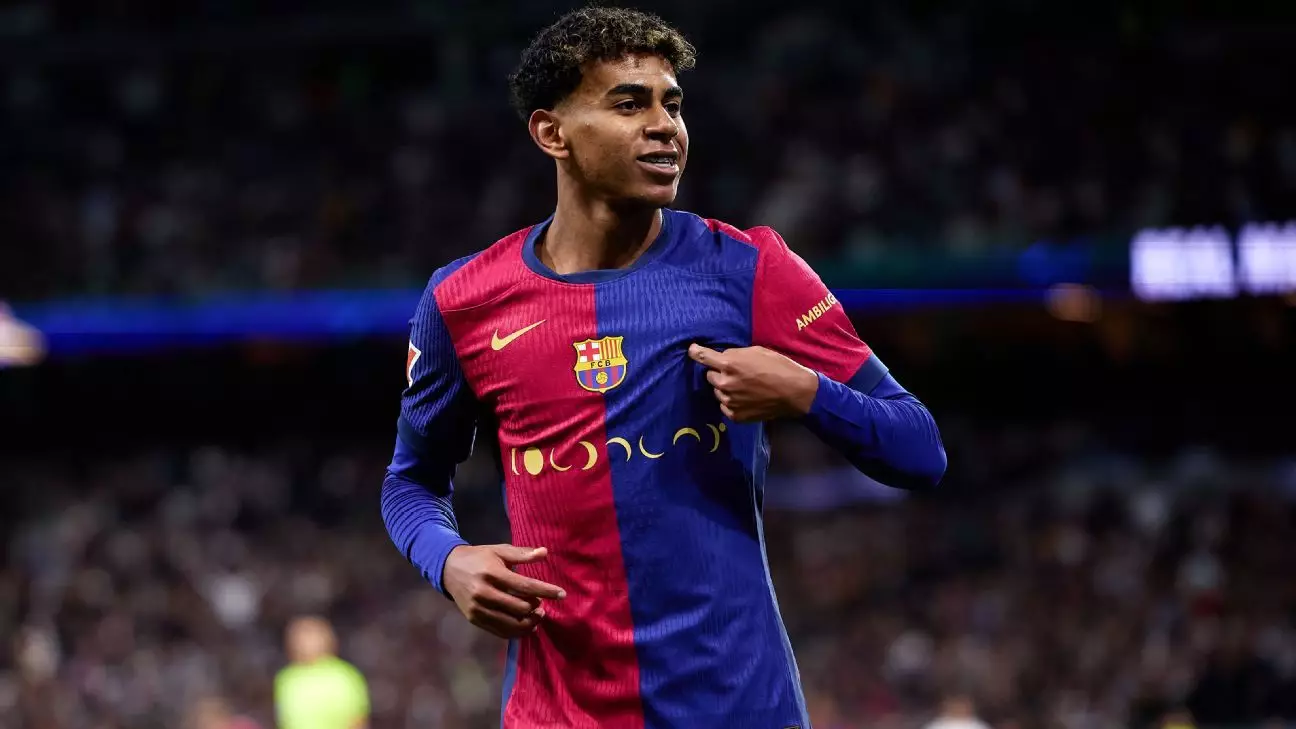
The prestigious Ballon d’Or has long signified excellence in soccer, serving as the game’s historical chronicle. This year marks a monumental shift as neither Lionel Messi nor Cristiano Ronaldo received nominations for the award for the first time since 2003. Their absence signals an undeniable conclusion to a dynamic era that has captivated fans and shaped modern football. While the award still grapples with inconsistencies—as highlighted by Dani Carvajal’s unexpected appearance in the rankings—the Ballon d’Or remains a key reference point for the sport’s narrative.
Despite Messi’s last victory in 2021 and his undeniable previous prowess, both icons have seen a downturn in their performances at elite levels in recent years. For instance, the last time Ronaldo was in the top three of Ballon d’Or voting was in 2019, and even Messi‘s brilliance faded post-December 2022, following the FIFA World Cup. This decline opens the door for a different narrative—one where the achievements of both players can be reassessed against the backdrop of contemporary talents.
End of the Messi-Ronaldo Saga in Football
In examining current players, we turn to the “Messi-Ronaldo Line,” which quantifies the combined rates of non-penalty goals and assists during the players’ formative years, extending from their respective debuts at age 17. This comparison not only contextualizes the individual greatness of Messi and Ronaldo but invites an evaluation of emerging talents across Europe’s top five leagues.
As we delve into the statistics of 2024, it’s evident how formidable the legacy of Messi and Ronaldo remains. Take Lamine Yamal, for instance, an emerging star from Barcelona—his impressive 0.73 non-penalty goals and assists per 90 minutes, while commendable, resides comfortably beneath the historic benchmarks set by the two legends. Similarly, other promising players, like Warren Zaïre-Emery, though possessing potential, have yet to breach the statistical thresholds established during their more illustrious counterparts’ prime years.

While performances are pivotal, they can also be misleading. The hype surrounding physical prowess and dribbling skills, as seen with young prospects, often overshadows the fundamental attributes that define elite football intelligence. Players like Jamal Musiala are quickly becoming the exception to the rule. His approach combines technical excellence with an understanding of game dynamics that could see him—and others—eventually seen in the same breath as Messi and Ronaldo.
Dissecting the performance averages of Messi and Ronaldo over the years reveals staggering figures. For instance, during their primes, both players consistently averaged over 1.5 non-penalty goals and assists per 90 minutes, a figure that seemingly only Harry Kane has approached in recent times. Yet, despite impressive individual seasons, few current players reach anywhere near the heights established by the two icons during their best years.
In contrast, current holders of the spotlight, such as Mohamed Salah and Kevin De Bruyne, demonstrate remarkable skill sets yet fall short of the historic narrative woven by Messi and Ronaldo’s illustrious careers. Salah, while formidable, averaged significantly less than the golden standards set forth by the legends, a recurring theme among their contemporaries.
Legacy and Future Prospects in Football
As the football community comes to terms with the reality of Messi and Ronaldo’s evolutionary decline, their impact on the sport can and must evolve too. Players like Kylian Mbappé and Bukayo Saka are being thrust into the limelight, with their performances prompting comparisons to the legendary duo. However, succeeding at the level they achieved requires more than momentary brilliance—it necessitates the development of all-rounded skills, resilient consistency, and, importantly, an understanding of football as both an art and a science.
Both Messi and Ronaldo transformed the narrative around what constitutes an elite player. They mastered their crafts, blending individual talent with an unyielding drive for team success. As the game progresses into this post-Messi-Ronaldo era, the future regarding the next generation of football hopes rests on players who not only aspire to match their statistics but who embody that same holistic greatness.
Ultimately, the departure of these two footballing titans reshapes the landscape, ushering in a pressing need for new legends to emerge. The challenge now lies in whether the players of today can transcend mere statistics and craft narratives extending beyond goals and assists. The legacy left by Messi and Ronaldo is profound, but the journey continues—a new chapter awaits.