
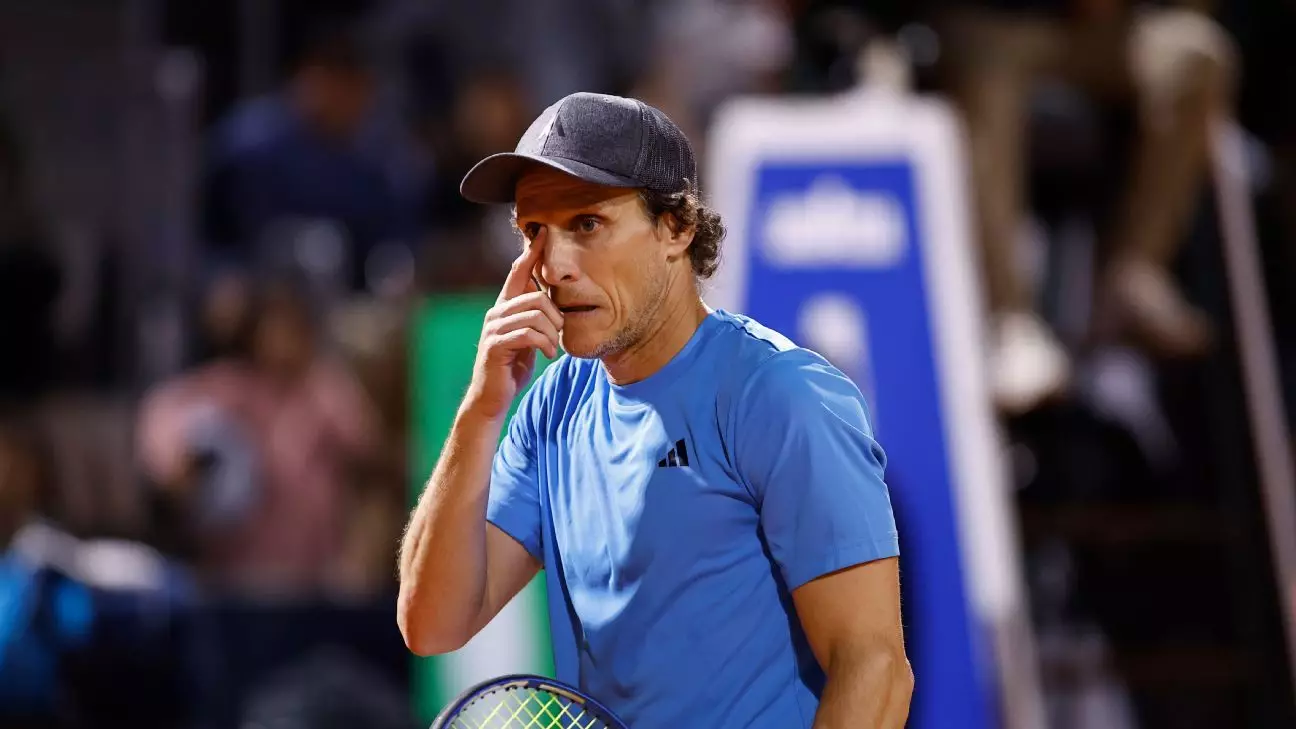
Diego Forlán, once a prominent figure in the world of football, is now charting a novel course in the realm of tennis. His recent debut at the Uruguay Open marked the official beginning of his journey in this sport, albeit with a challenging start. At 45 years old, Forlán, partnered with Argentine player Federico Coria, faced a steep uphill battle against the skilled duo of Boris Arias and Federico Zeballos. The match ended in a decisive loss, with a score of 6-1, 6-2, highlighting the difficulties of transitioning between two vastly different athletic pursuits.
Despite the unfavorable outcome, Forlán radiated positivity in his post-match comments. He openly acknowledged the tough nature of the competition, showing a mature understanding that success in sports can’t always be guaranteed. His attitude reflects a significant aspect of sport: the importance of enjoyment and camaraderie over mere victory. Forlán’s ability to appreciate the experience rather than solely focusing on the scoreboard underscores a vital life lesson that resonates beyond athletics. He echoed immense gratitude towards the local fans, whose enthusiastic support filled the stands, affirming his connection with the Uruguayan community.
Forlán’s illustrious football career serves as a foundation for his current endeavors. With a resume that boasts stints at world-class clubs—including Manchester United, Atlético Madrid, and Inter Milan—it is no surprise that he was celebrated not only as a prolific striker but also as a key figure in major tournaments. His crowning achievement came during the 2010 FIFA World Cup when he was awarded the title of the tournament’s best player, a testament to his skill and competitive spirit. Add to this his critical role in securing Uruguay’s triumph in the 2011 Copa América, and it’s clear that Forlán has left an indelible mark in sports history.
The Transition to Tennis
After retiring from professional football in 2019, Forlán’s transition to tennis has been gradual. His participation in amateur master’s tournaments over the past five years indicates not only his passion for tennis but also a commitment to embracing new challenges. This background has undoubtedly prepared him for the trials of professional competition, offering valuable experience that translates well into his new athletic pursuit. Receiving wild-card entries to compete at a significant event like the Uruguay Open is a recognition of his efforts and achievements in the amateur circuit.
As Forlán continues to navigate this new phase of his life, it remains to be seen how he will develop his skills on the tennis court. While his debut may not have gone as planned, his enthusiasm highlights an inspiring aspect of athleticism: the pursuit of joy through competition. Forlán’s journey serves as a reminder that transitions, regardless of their outcomes, can lead to personal growth and fulfillment—an essential part of any athlete’s career. The way he approaches the rigors of professional tennis will likely captivate sports fans and inspire former athletes considering new challenges in their lives.