
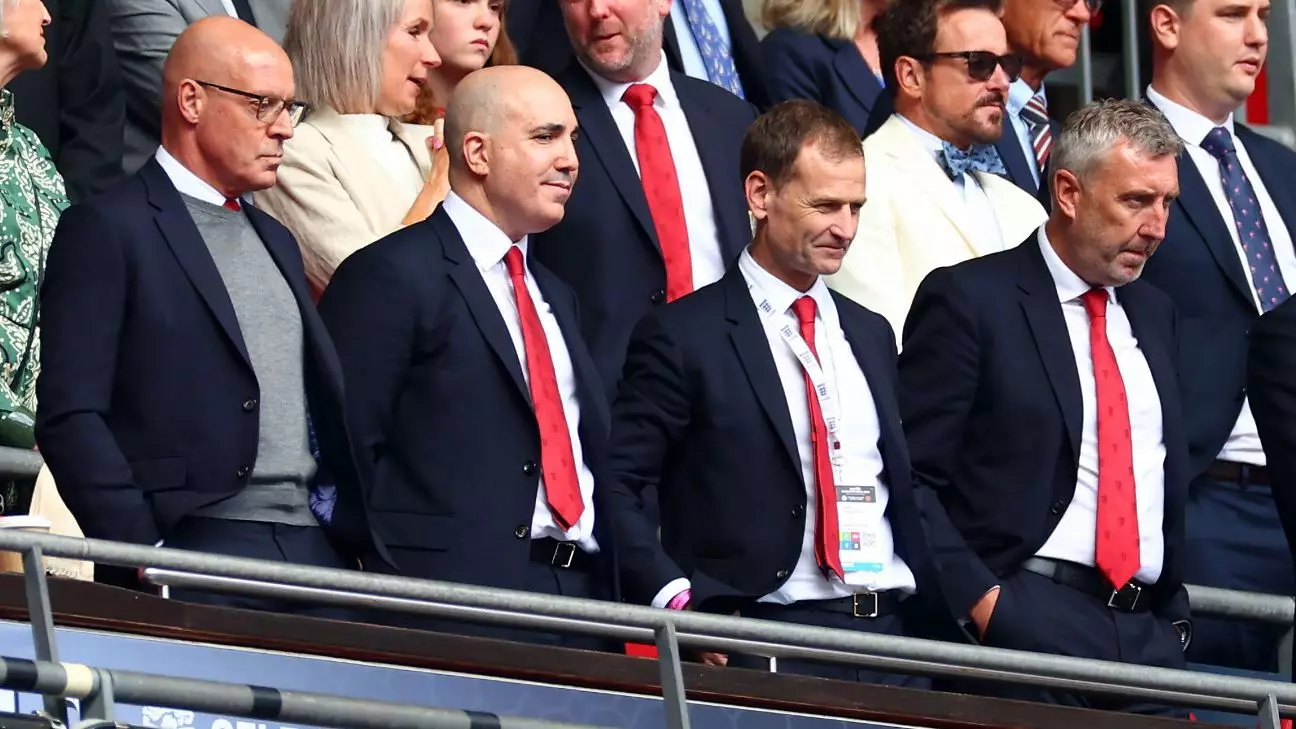
The dynamics within a football club play a pivotal role in its success on the pitch. No matter how skilled a head coach may be, their performance is deeply intertwined with the efficiency and effectiveness of the sporting director responsible for talent acquisition and squad building. Manchester United’s decision to terminate Dan Ashworth’s contract merely five months into his tenure is a clear indication of the urgency felt within the club as they seek to regain their competitive edge under new manager Ruben Amorim. This swift action raises questions about the decision-making framework at Old Trafford and underscores the broader challenges facing modern football clubs.
Reports indicate that Sir Jim Ratcliffe, United’s minority owner and the primary figure behind decision-making at the club, swiftly grew disenchanted with Ashworth’s performance. The assertion that he lacked both the requisite personality and skill set needed for the role suggests a stark misalignment between Ashworth’s profile and the demands of a club in crisis. With relations between Ashworth and Ratcliffe described as “rocky,” it became evident that the club could not afford the luxury of time to rectify a situation that appeared unlikely to improve.
During Ashworth’s brief reign, he was responsible for overseeing a significant summer transfer window, in which United splurged an impressive £182 million on five new signings. However, this investment has not yielded the anticipated returns. As of now, only defender Noussair Mazraoui—signed for a relatively modest fee—seems to have proven value, casting serious doubts over the efficacy of Ashworth’s recruitment strategy.
The dismissal of Ashworth further illustrates the financial pressures currently plaguing Manchester United, exemplified by losses amounting to £113.2 million in their most recent accounts. To compound these issues, the club’s failure to secure a position in the lucrative Champions League further exacerbates their financial strain. In an era where data analytics inform many of the decisions surrounding player acquisitions and tactical strategies, the acknowledgment from Ratcliffe that United is “in the last century” concerning data analysis illustrates a significant operational lag.
Despite Ashworth’s limited time to make a mark, the urgency shown by Ratcliffe indicates an acute awareness of the competition. Other clubs have already embraced data analytics, cycling through player selections with speed and efficiency. Days of intuition in the transfer market are fading fast, replaced by a structured, analytical approach that emphasizes sustainable investment.
The circumstances surrounding Ashworth’s departure could have profound implications for future signings. According to multiple sources, Ashworth was instrumental in signing several players during the challenging summer window, many of whom have not yet met expectations. Notably, forward Joshua Zirkzee, despite being brought in for a substantial £36 million, has struggled with form, netting just three goals in 21 matches. Similarly, defensive midfielder Manuel Ugarte’s inconsistent performances have yet to justify his hefty price tag from PSG.
The question that remains following Ashworth’s departure is not just about his decisions but about the future direction of United’s recruitment strategy. The lost opportunity for Ashworth to synthesize his vision for the club’s squad with the managerial aspirations of Ten Hag has inevitably led to questions surrounding the club’s future trajectory. Allowing such a disconnect to flourish could be detrimental to their hopes for success.
Contrast Ashworth’s turbulent stint with that of Michael Edwards, the former sporting director at Liverpool. Edwards’s innovative player recruitment methods contributed greatly to Liverpool’s resurgence as a Premier League powerhouse, culminating in league and Champions League titles. His ability to identify hidden talents and unearth potential from less-fancied markets lays the groundwork for a template that United must aspire to emulate. Ratcliffe’s ambition for United suggests a desire for a structural overhaul that prioritizes innovation, agility, and astute recruitment.
In this context, the incoming sporting director, likely Hugo Viana, faces immense pressure to learn from Ashworth’s tumultuous chapter. If Viana can apply lessons from successful figures like Edwards while also leveraging the network from his time at Sporting CP—the club that Amorim managed—his tenure could mark the beginning of a new, more prosperous era for Manchester United.
In football, the margins for error are incredibly thin, and the stakes could not be higher for clubs like Manchester United. While managers are judged by results on the pitch, sporting directors are evaluated based on the long-term impact of their recruitment strategies. In Ashworth’s case, the consequences of inadequate signings have already led to his departure. As United looks to reclaim their status as a footballing titan, the onus will be on the new leadership, particularly in recruitment, to not only learn from past failures but to innovate and adapt in a rapidly evolving sport. The journey to the top will be fraught with challenges, but the need for resilience and foresight is paramount as Manchester United seeks to rewrite its narrative in the annals of football history.