
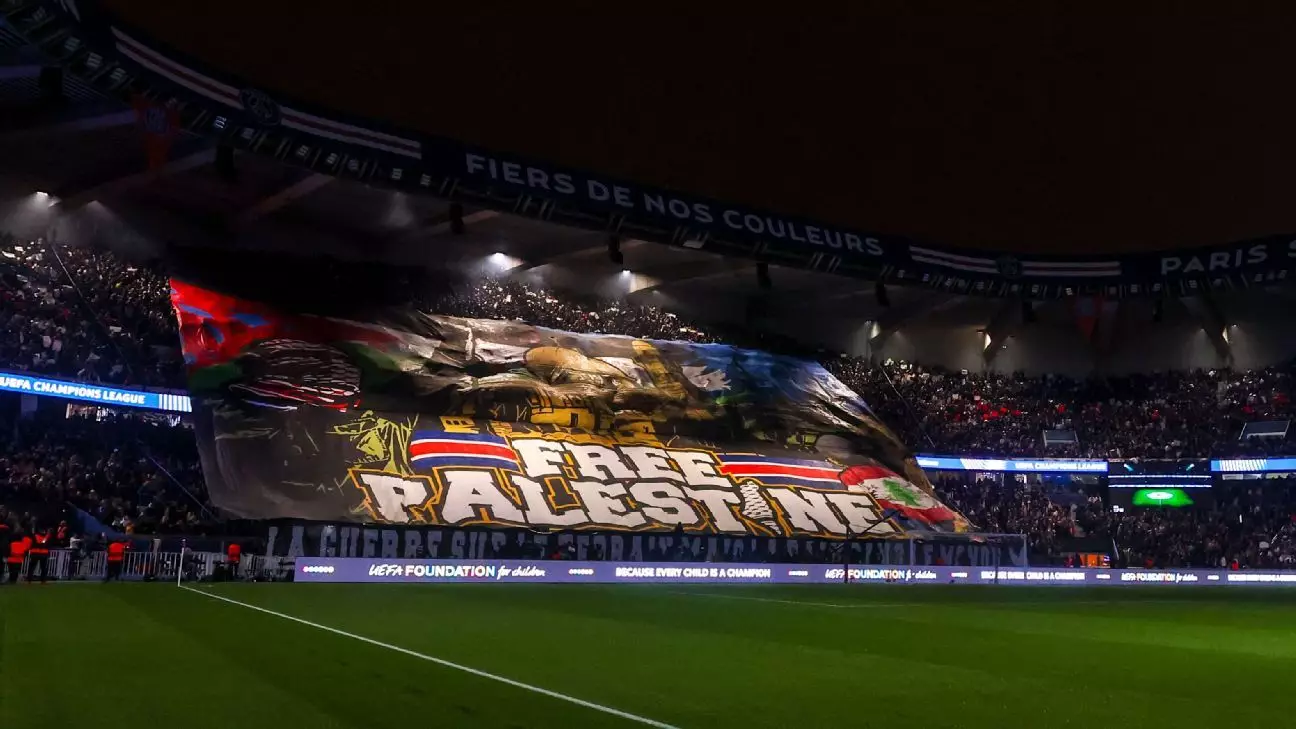
In a striking display of political sentiment, fans from the Auteuil Kop section of Paris Saint-Germain (PSG) unveiled a giant “Free Palestine” banner prior to their Champions League clash against Atlético Madrid. The timing of this protest was particularly poignant, occurring just days before France’s upcoming Nations League fixture against Israel. The powerful message underneath the banner, “War on the pitch, but peace in the world,” encapsulates a call for unity amidst global conflicts, revealing how sports can serve as a platform for larger social issues.
The act of displaying such a banner at a prominent sporting event underscores the fans’ commitment to raising awareness about the plight of Palestinians, especially children suffering due to prolonged conflict. Further intensifying the message, during the match, another banner stated, “Does a child’s life in Gaza mean less than another?” This rhetorical question urges spectators to reflect critically on the value of life and humanity in the context of geopolitical strife.
In response to the unexpected political demonstration, PSG promptly distanced itself from the fans’ actions. The club issued a statement that expressed its lack of prior knowledge regarding the plans to display such political messaging. PSG emphasized that the Parc des Princes should remain a neutral and unifying space dedicated to soccer, firmly opposing any politicized messages within its venue. This statement appears to reflect the tensions that arise when sports, often seen as apolitical, intersect with social and political issues.
The reaction from French Interior Minister Bruno Retailleau was swift and stern. Labeling the unveiling of the banner as “unacceptable,” he suggested that potential sanctions against PSG were on the table. The weight of his comments indicates a serious concern over the safety and appropriateness of allowing political messages to permeate sporting events, particularly in a nation with complex demographic and political dynamics.
This incident is not isolated; it follows a pattern where sporting events become venues for political expression. For instance, last year, Celtic faced financial penalties for allowing fans to wave Palestinian flags during a Champions League match. Such occurrences raise broader questions about the role of sports in society—should athletes and fans be permitted to express their views on pressing global issues, or should the sports arena remain detached from political discourse?
As anticipation builds for the upcoming match between France and Israel at the Stade de France, concerns regarding security loom large. This game will be held in a venue that not only accommodates tens of thousands of fans but also highlights the delicate demographic makeup of France, which possesses the largest Jewish community in Europe and a significant Muslim population. These factors complicate the social fabric within which sports operate, amplifying the importance of the dialogue surrounding the intersection of politics and sports.
The banner unfurling at the PSG match serves as a powerful reminder of the responsibilities that come with platforms of influence. As society grapples with these questions, it remains essential to explore how sports can contribute to meaningful conversations about justice, peace, and humanity.