
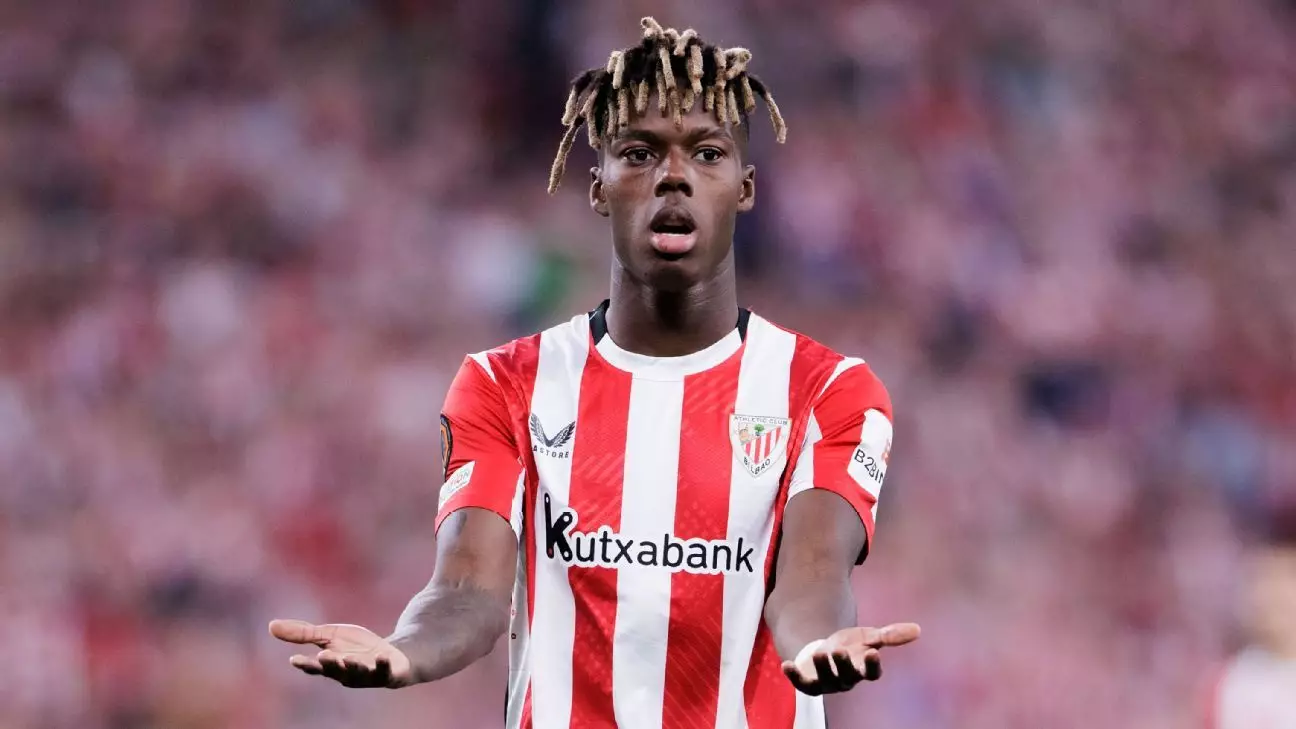
As the winter transfer window approaches, European football clubs are bracing for a flurry of activity, with marquee players potentially changing jerseys. One of the most intriguing developments is Real Madrid’s pursuit of Nico Williams, the Athletic Club winger whose scintillating performances have captured attention across La Liga. The reports suggest that a move for the 22-year-old could be straightforward, bolstered by a €58 million release clause. What makes Williams particularly enticing is not just his skill set but also the symbolic gesture that signing him would represent: a strategic victory over their arch-rival Barcelona. For Madrid, securing players whom their competitors are also eyeing provides a psychological edge in a sport where dominance is often as much about instinct and intrigue as it is about technical ability.
Williams embodies a blend of youth and flair, qualities that Madrid can leverage to maintain their competitive edge both domestically and in Europe. However, the acquisition of Williams could trigger a reshuffle within the squad, most likely resulting in Rodrygo’s departure from the Bernabéu. Such an exodus, while potentially detrimental in terms of squad depth, might also be an opportunity for Madrid to recalibrate their roster, channeling resources into more impactful signings. This strategic maneuvering underscores the broader landscape of modern football, where talent and financial prowess often intertwine.
Barcelona’s Gamble on Luis Díaz
Over in Catalonia, Barcelona has set its sights on Luis Díaz, the dynamic forward from Liverpool, making him their primary target for the upcoming transfer window. At an asking price of €85 million, securing the 28-year-old would require significant financial investment. However, the urgency reflects a strategic gamble: Barcelona seeks a left winger who can seamlessly transition to central roles within their attacking framework. The departure of certain high-profile figures, coupled with the constant pressure to reclaim the La Liga title, amplifies the importance of such a signing.
Díaz’s versatility makes him a valuable asset for a Barcelona side that has been grappling with inconsistent performances. Entrenching a player of his caliber into the squad could, in theory, offer a quick fix to many of their striking woes. Nonetheless, in a market rife with competition, dragging this transfer over the line amid financial uncertainties will prove challenging. The strategic question for Barça revolves not only around immediate success but also about building a long-term vision that aligns with their storied legacy.
Liverpool’s Shrewd Substitutions
Meanwhile, Liverpool finds itself in a position to pull off a shrewd signing of their own. Xavi Simons, the RB Leipzig attacking midfielder, has emerged as a potential target, touted as a more economical alternative to Bayer Leverkusen’s Florian Wirtz. Liverpool’s interest indicates a shift in strategy: the club seems to be exploring options that not only align with their financial capacities but also promise the dynamism that manager Jurgen Klopp requires for his high-octane football. This pivot showcases the shifting paradigms within top-tier clubs as they become more analytical, valuing financial sustainability alongside success on the pitch.
The burgeoning interest in Simons illustrates just how much tactical nuance remains paramount in the transfer market; every acquisition must serve multiple purposes—bolstering the squad while also being financially viable. This paradigm shift towards analytics and long-term strategy presents a stark contrast to the traditional approaches common in the bygone eras.
The Challenges of Keeping Up
Clubs like Manchester City are also facing setbacks as they navigate the ever-evolving transfer landscape. The recent reports indicate that their interest in AC Milan’s left-back Theo Hernández has dimmed due to his preference to remain in Serie A, despite the financial might of Premier League clubs. This serves as a reminder that player loyalty and personal choices increasingly play central roles in transfer negotiations. The reluctance of Hernándes underscores a broader challenge facing clubs like City: how do you convince top talent to make a move when they might have a strong emotional connection to their current club?
As the transfer window looms, clubs must brace not just for the rapid-fire negotiations but also for a landscape where savvy choices, emotional ties, and financial prudence collide. In this fast-paced environment, every decision carries weight, not just for the immediate future but for the long-term ambitions of the clubs involved. The juxtaposition of aspiration and reality creates a thrilling narrative that underscores the unpredictable nature of football.