
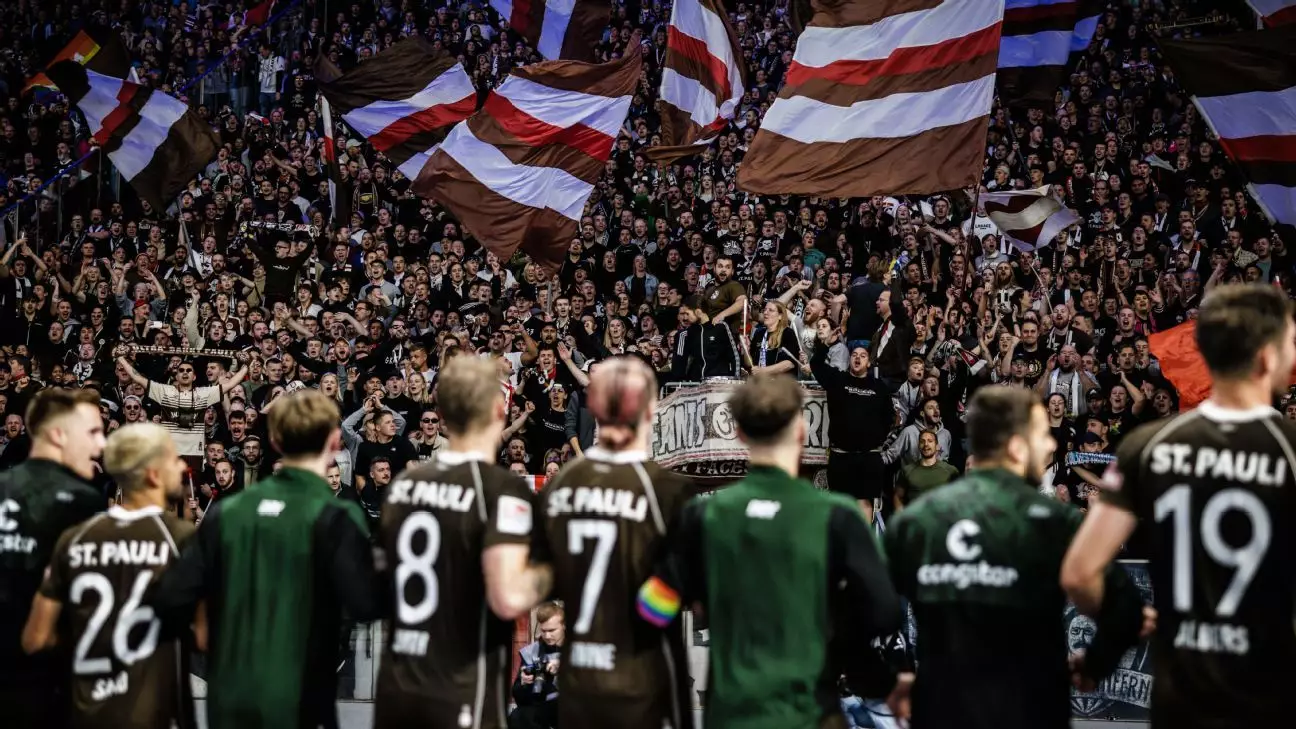
In a world increasingly polarized by politics and sport, the intersection of the two often stirs up heated debates. Yet, in Germany, particularly in Hamburg, the case of FC St. Pauli illustrates that such a merger can define a club’s identity. For the Kiezkicker, as they are affectionately known, football is much more than a game; it is a vehicle for social change, reflecting the values and challenges of their community.
St. Pauli has long been more than just a football team; it is a cultural movement deeply embedded in the socio-political landscape of Hamburg. Located near the notorious Reeperbahn and the docks, their environment has shaped the club’s ethos. The Kiezkicker has cultivated a reputation for representing marginalized voices and fostering an inclusive atmosphere, placing importance on human rights and community activism. This is reflected in their founding principles, known as the Leitlinien, which advocate against fascism, racism, homophobia, and all forms of discrimination.
Endorsements such as “Refugees Welcome” and “No One Is Illegal” are visible throughout their district. These slogans, displayed prominently on stickers and banners, encapsulate St. Pauli’s unwavering commitment to social justice and equality, making it an attractive choice for fans who share similar egalitarian beliefs.
The club’s journey toward becoming a beacon of progressive values began in notable historical circumstances. In the vibrant 1980s, when Hamburg was marked by alternative culture, club supporters rallied around social issues such as housing rights for the homeless and opposition to far-right extremism. This commitment to activism has been a counter-narrative to the often-toxic environment found in European football, which saw clubs grappling with hooliganism and right-wing allegiance.
By the 1990s, St. Pauli adopted its iconic skull and crossbones logo, a symbol that captures both their punk ethos and their rebellious spirit. The origin of this logo can be traced back to a spirited fan who brought a pirate flag to a match, symbolizing the club’s unique identity and its unyielding stance against mainstream norms. This change resonated with fans far and wide, marking the beginning of a significant increase in the club’s following.
Today, attending a match at the Millerntor Stadium is less about the results on the pitch and more about the vibrant atmosphere created by devoted supporters. The experience is akin to a spirited celebration, where music and fan engagement are essential components. Songs like AC/DC’s “Hell’s Bells” and promotional anthems, such as Blur’s “Song 2,” echo throughout the stadium, fostering a sense of unity and excitement amongst fans.
Despite fierce competition for tickets—where demand often surpasses availability—those fortunate enough to witness a game are left with a taste of a culture that feels profoundly different from corporate-driven football leagues elsewhere. This unique appeal has led to a growing international fanbase, who appreciate the club’s authenticity and commitment to their community’s values.
As St. Pauli prepares to face giants like Bayern Munich, the memory of their historical win against them in the 2001-02 Bundesliga season lingers in the minds of many fans. Although St. Pauli finished last that season, the unexpected victory redefined their potential, generating a term among fans—Weltpokalsiegerbesieger, translating to “conquerors of the World Club Cup winners.” Such victories against financially superior rivals bind the community together, reinforcing the belief that St. Pauli represents more than just a football club; they embody a collective dream against the odds.
This season, under the leadership of manager Alexander Blessin, St. Pauli has focused on forming a competitive team that remains grounded in its identity. With a modest wage bill compared to Bayern’s, they have achieved a balance in performance, showcasing a resilient defense bolstered by a squad with strong ties to the local fabric.
Moving Towards Cooperative Ownership
An exciting recent development is the club’s initiative to launch a Genossenschaftsmodell, a cooperative ownership model. Fans can purchase shares to gain voting rights, reinforcing the principle that each supporter has an equal voice in the club’s decisions, thus rejecting the notion of wealth dictating influence. This equitable approach is a significant departure from the commercial practices dominating modern football, aligning perfectly with the club’s founding values.
President Oke Göttlich’s recent media presence emphasized this initiative, which not only facilitates debt relief but also aims to improve club facilities and services. The model is a testament to the power of community engagement, allowing fans to participate actively in shaping the future of their beloved club.
As millions tune in to watch St. Pauli compete against Bayern Munich this week, they will witness more than just a football match. They will participate in a celebration of activism, community spirit, and the power of sport to enact social change. In a world where divisions often seem insurmountable, St. Pauli stands as a reminder that football can indeed be a force for good—uniting people around shared values of equality, justice, and solidarity.