
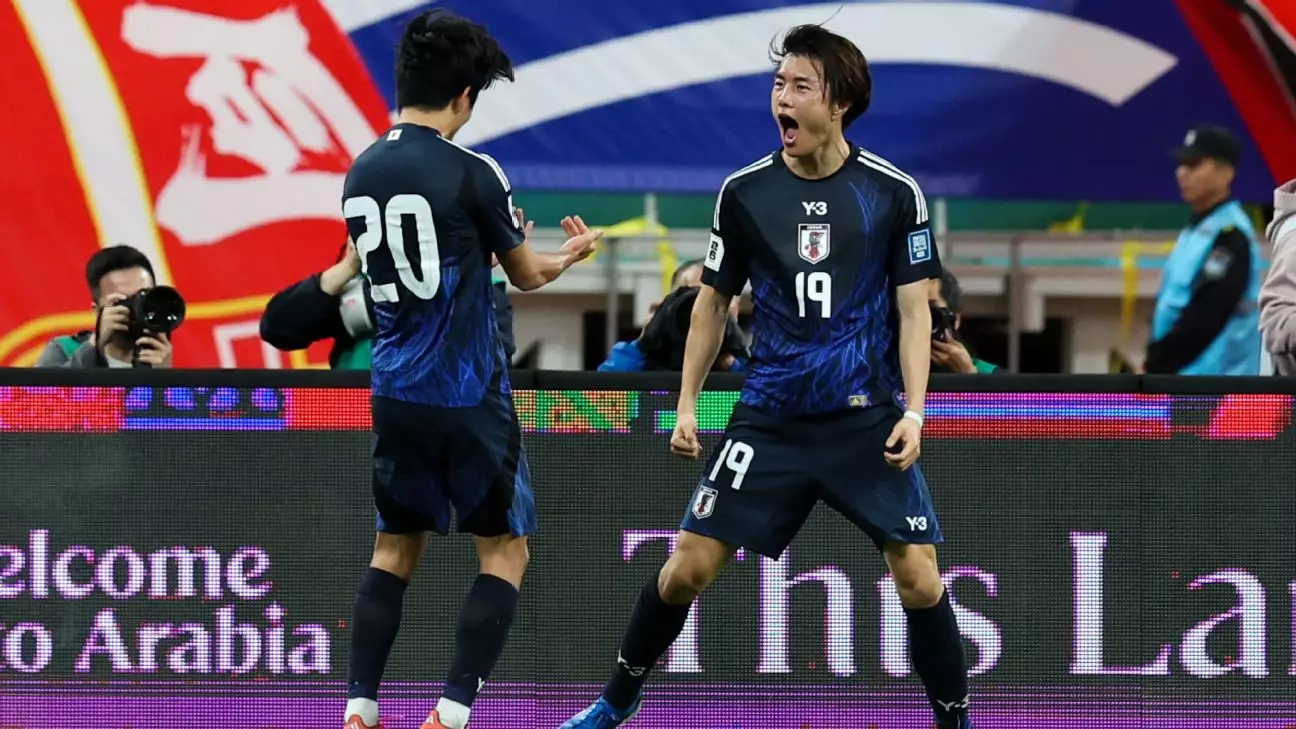
As the world watches the unfolding narrative of the 2026 FIFA World Cup qualifiers, Japan stands poised for a remarkable achievement. With just four matches left in the Asian qualifying rounds, the Samurai Blue have already made significant strides towards securing their spot in football’s most prestigious tournament. Currently dominating Group C with a commanding nine-point lead, Japan’s next challenge is to clinch qualification early on March 20 against Bahrain. However, mere participation in the World Cup no longer suffices for this footballing nation with ambitions that stretch far beyond just making an appearance.
Under the leadership of coach Hajime Moriyasu, the collective mindset within the Japanese football framework has shifted dramatically. Winning the World Cup has transitioned from a distant dream to a goal marked in bold letters on Japan’s aspirations. The Japan Football Association has launched an ambitious initiative dubbed “The JFA Pledge for 2050,” which commits to winning the World Cup by then, while also aiming for the semifinals by 2030. This declares Japan’s intent to not just participate but to emerge as contenders, a statement of confidence and a departure from a history marked by quarterfinal exits.
Moriyasu did not explicitly claim that Japan would win the upcoming World Cup, yet his declaration can lead one to wonder: could the Samurai Blue realistically compete? To gauge their potential, it is crucial to consider four vital components.
A critical factor in Japan’s burgeoning fortunes resides in the quality of its starting eleven. Recent history indicates that Japan is not merely a dark horse. The team’s remarkable performance in the last World Cup, where they triumphed over football giants Germany and Spain, is a testament to their potential. Moreover, the squad has experienced a significant infusion of talent, featuring players from notable European leagues who contribute regularly to their clubs.
Currently, Japan boasts a formidable lineup, with players like Zion Suzuki of Parma, central defenders Ko Itakura, Shogo Taniguchi, and Koki Machida, as well as an attacking midfield packed with talent in the form of Ritsu Dōan, Wataru Endō, Hidemasa Morita, and Kaoru Mitoma. While there remains competition for starting positions—evidenced by the throngs of talented players like Daichi Kamada and Ao Tanaka—what stands out is Japan’s emergence as a more cohesive unit, one that centers teamwork over individual glory.
However, depth remains an area where Japan must grow. Despite possessing a talented core, the supporting cast has yet to consistently deliver on the international stage. Players like Daizen Maeda and Kyogo Furuhashi have yet to showcase their abilities fully for the national team. Furthermore, the continued inclusion of the veteran Yuto Nagatomo, while commendable, highlights a broader concern over a lack of emerging talent to strengthen the roster.
The Samurai Blue have had their share of key players sidelined due to injuries, underscoring the importance of nurturing a robust pool of alternatives. The absence of impactful substitutes diminishes competition for starting positions and hampers overall team dynamism. If Japan hopes to combat football’s elite, developing a more profound bench strength is imperative for their advancement.
Moriyasu’s tactical evolution is a noteworthy aspect that reflects Japan’s changing approach. Originally criticized for a conservative playstyle, evident in the previous World Cup matches, he has gradually embraced a more audacious system, utilizing attack-minded players such as Mitoma and Dōan as wing-backs. This strategy has led to Japan effectively deploying seven offensive players, an approach that invigorates their style of play.
The question now remains whether Moriyasu will maintain this attacking ethos when faced with more formidable European and South American teams. His tactical choices will be pivotal in determining how well Japan can navigate the pressures of high-stakes matches, where both positive and negative tactics could define their outcomes.
Japan’s football identity, rooted in respect and humility, has sometimes translated into a cautious mentality on the pitch. Yet, the need for a ruthless attitude cannot be understated. To balance humility with healthy ambition, players must cultivate a mindset that embraces victory over mere participation.
Recent performances indicate a welcomed change in Japan’s mentality—a growing confidence reminiscent of a team that is beginning to realize its potential. Their clinical demolitions of weaker opponents, illustrated by hefty victories, depict a burgeoning belief that they can dominate theirs. A fine line exists between humility and the assertiveness needed to become champions, and Japan must walk it wisely.
With World Cup qualification almost secured, the Samurai Blue’s ambitions stretch far beyond the group stage. It is no longer sufficient for Japan to merely adhere to being a traditional Asian powerhouse; they now aim for global prominence. Achieving a place in the quarterfinals and beyond will require an unwavering commitment to nurturing talent, evolving tactics, and embracing a winner’s mindset.
Japan is at a paradoxical moment—a bright horizon awaits, marked by lofty dreams and tangible aspirations. The ultimate goal might be formidable, but the journey toward realizing it promises to be equally rewarding. As they prepare to pen this new chapter in their footballing history, the Samurai Blue have the potential to surprise and inspire those watching from around the world.