
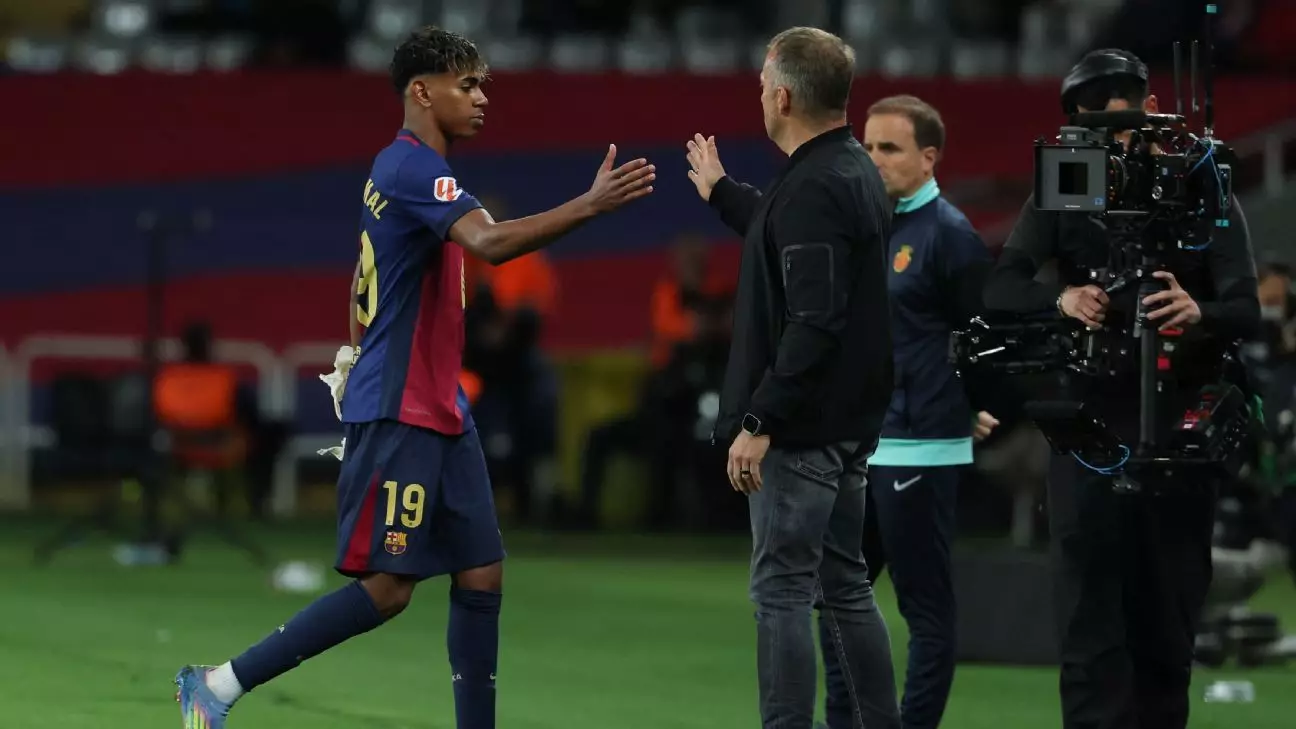
In a match that left fans both electrified and exasperated, Barcelona’s recent 1-0 victory against Mallorca epitomized the duality of football: one team’s dominance translates into a disjointed reality where numbers deceive. Under the watchful eye of coach Hansi Flick, the Catalan giants unleashed a staggering 40 shots—an achievement that echoes throughout LaLiga’s storied history, tying them with Real Madrid for the most shots in a match since 2003. Yet, while the scoreboard announced a narrow victory, the harrowing efficiency—or lack thereof—of this prolific attack begs critical examination.
Flick, a strategist who prides himself on tactical acumen, seemed unfazed by the glaring reality that only Dani Olmo’s second-half goal separated his team from a disappointing scoreline. His assertion that “it was 40 shots, maybe not on target,” highlights a coach grappling with the contrasting significances of control and execution. The margin of victory wasn’t merely a statistic; it illustrated an unsettling truth about Barca’s performance that could rear its head against stronger opposition.
The Anomaly of Anxious Attack
The first half presented a glaring paradox: the more shots Barcelona accumulated, the more tense their gameplay seemed to become. With 24 attempts before the interval, players appeared not only overwhelmed by the pressure to convert but also perhaps a touch ambivalent towards the idea of failure. Gavi hitting the post and Ronald Araújo squandering a golden opportunity epitomized their struggle to translate dominance into definitive outcomes.
Goalkeeper Leo Román’s impressive introduction to Mallorca’s squad, culminating in 12 saves, further accentuated Barcelona’s shooting woes. Yet one cannot overlook the psychological toll of profligacy in front of goal; every miss compounds doubts and momentum shifts. Flick’s positive mindset is commendable. Still, in a sport where fine margins define success, one has to wonder if an over-reliance on controlling the game rather than finishing it off could ultimately hinder Barcelona’s forward momentum.
Ansu Fati: Return of a Prodigy?
Attention inevitably shifted to Ansu Fati, who made a long-awaited first start since October. With just two matches under his belt this season, his impact on the pitch was both heartening and sobering. Tasked with igniting the offense alongside other talents, Fati’s four shots reaffirmed Flick’s belief in his abilities, despite lingering questions about his match fitness and confidence—a reality rendered more acute given the magnitude of opportunities squandered.
Flick’s optimism regarding Fati’s development is palpable, asserting that support from teammates and fans alike could herald a resurgence in the young star’s career. However, whether this encouragement translates into consistent performance will be vital for Barcelona, particularly as their focus sharpens towards upcoming challenges in the Copa del Rey final.
The Defensive Resurgence
Amidst the struggles in attack, a silver lining emerged in Barcelona’s defensive strategy. Flick noted the team’s improved organization and discipline, signifying a gradual evolution in their play. Achieving a clean sheet, particularly while experimenting with a different lineup—resting key players such as Frenkie de Jong and Jules Kounde—illustrates a depth in the squad that could serve well in high-stakes fixtures.
Robust defensive displays can be the backbone of great campaigns; however, they must operate in harmony with a potent attack. The tension between offense and defense is a dance that Barcelona must perfect if they wish to reclaim their place atop Spanish football. The dichotomy of their performance against Mallorca left fans craving greater efficiency and a more decisive execution as they navigate an arduous season ahead.
The Road Ahead for Barcelona
As the team prepares for the impending Copa del Rey final, Flick’s decision to rotate his squad may prove prudent, but one can’t ignore the unsettling question of squandered chances. While positive signs exist, it remains imperative for the coach and his players alike to recalibrate their focus—balancing creativity with ruthlessness in front of goal. The outcome against Mallorca showcases more than just a singular victory; it’s a reflective moment for a squad at a crossroads, needing to harmonize their shooting boots with the artistry of their football before they can embark on the glory they desperately seek.