
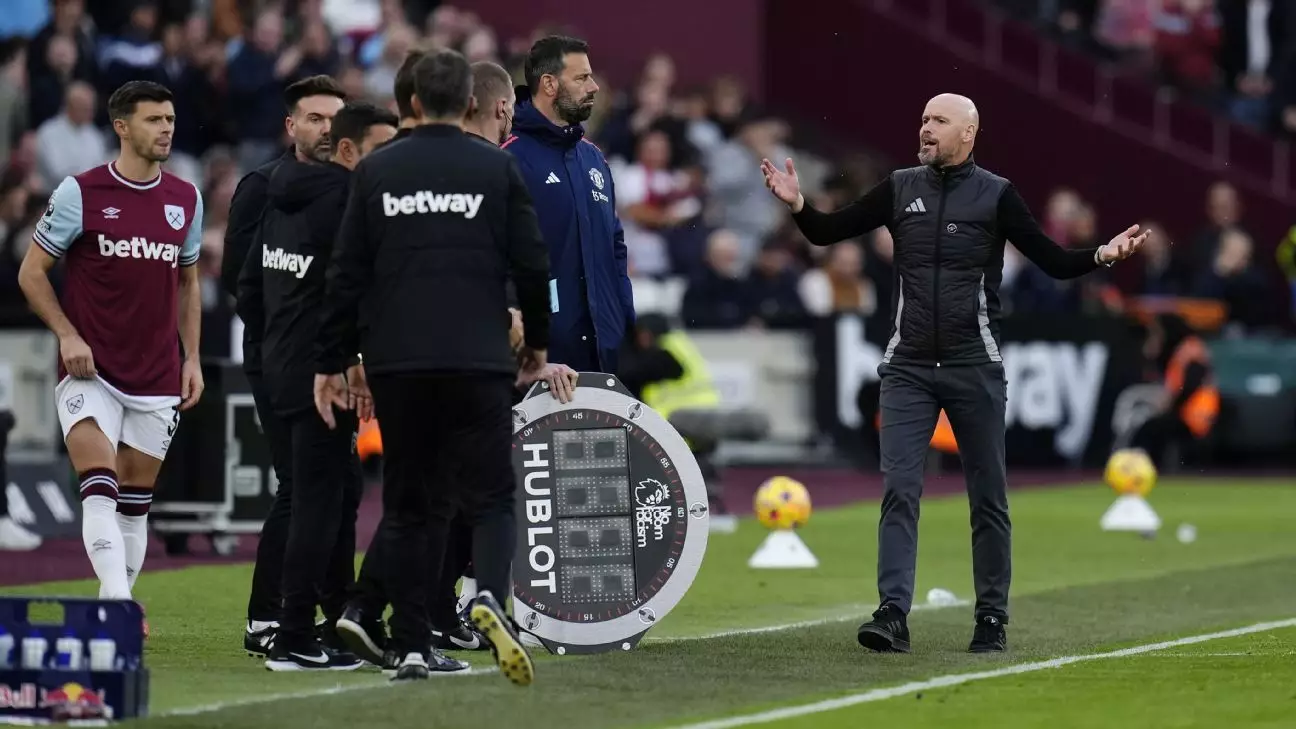
The Premier League, known for its passionate fans and intense rivalries, is once again at the center of a storm surrounding officiating standards, particularly the video assistant referee (VAR) system. Recent events, including a heated post-match exchange by Manchester United manager Erik ten Hag after his team’s narrow defeat to West Ham, highlight the ongoing frustration within the football community regarding the decision-making processes of referees. This particular incident raises critical questions about the effectiveness and reliability of VAR and its impact on the outcome of pivotal matches.
On a crisp Sunday afternoon at London Stadium, Manchester United entered the match hoping to build momentum after a string of mixed results. Despite controlling large portions of the game and seeming poised to secure at least a point, the tide turned dramatically in the dying moments when a collision between Matthijs de Ligt and Danny Ings triggered a penalty review. Although the incident bore a questionable degree of contact, referee David Coote, under the advisement of VAR Michael Oliver, opted to award a penalty to West Ham’s Jarrod Bowen. The young forward stepped up to convert, sealing a 2-1 victory that further complicated United’s ongoing struggles in the league.
Erik ten Hag’s post-match comments reflected deep-seated frustration not just about the specific decision regarding the penalty, but about the broader framework within which these decisions are made. He articulated that despite the notion that better teams should win, the reality often diverges from this ideal due to officiating inconsistencies. Ten Hag specifically questioned the “clear and obvious” standard set by the FA for VAR reviews; he criticized past decisions where officials failed to intervene, suggesting that such discrepancies impact the integrity of the game. His critique was not directed at individual referees but rather the flawed procedures governing the review system.
The ongoing debates around VAR underscore a critical issue facing the Premier League: the paramount need for consistency in officiating standards. For every contentious decision like the one seen in the match between United and West Ham, there seems to be a contrasting example where a blatant foul goes unpunished, as was the case for Bruno Fernandes against Tottenham Hotspur earlier in the season. This lack of consistency fuels dissatisfaction among players, managers, and fans alike, creating an environment rife with uncertainty and frustration every time a VAR decision is called into question.
The defeat to West Ham has serious implications for Manchester United’s season; now languishing in 14th place, the pressure mounts on ten Hag and his squad. With only three wins in the first nine matches of the Premier League season, United faces increasing scrutiny. Ten Hag remains hopeful, acknowledging the role luck plays in the game while emphasizing the need for collective determination to turn their fortunes around. The manager’s confidence in his team’s recent performances, despite their struggles in the league, illustrates a commitment to consistency as they prepare for upcoming fixtures, including a Carabao Cup match against Leicester City and a league clash with Chelsea.
As VAR continues to instigate heated debates and dissatisfaction in the world of football, it is crucial for authorities to re-evaluate the system’s implementation and its overarching protocols. The stakes are high not only for clubs like Manchester United struggling to find their footing but also for the integrity of the league as a whole. Moving forward, stakeholders must prioritize a review of the decision-making processes surrounding VAR to ensure that the beautiful game is defined by skill and competition rather than by contentious and variable officiating standards. Ten Hag’s reflections might just be the tipping point for advocating necessary changes that could lead to a more fair and accountable officiating style in English football.