The Grafting Goliath: Pep Guardiola’s Struggles Amidst Manchester City’s Misfortunes
In what can only be described as a dramatic fall from grace, Manchester City finds itself teetering on the brink of elimination from the prestigious Champions League. Just a month ago, the notion that Pep Guardiola’s managerial prowess would be questioned was unfathomable. However, following their 2-0 defeat to Juventus, the team’s disastrous run—seven losses in ten matches—raises serious concerns about their future. With City currently languishing in 22nd place in the Champions League rankings, a precarious one-point buffer above the last-place position, the imminent clash against Paris Saint-Germain looms large, as players and fans alike brace for another potential setback.
The defeat to Juventus marks a watershed moment, with goals from Dusan Vlahovic and Weston McKennie cutting deep into City’s ambitions. As they prepare for their next game against PSG in Paris, the threat of falling out of the Champions League adds an agonizing layer to City’s woes. Following their triumphant campaign that saw them crowned Champions League winners in 2023, this new reality feels like a dismal chapter in their story.
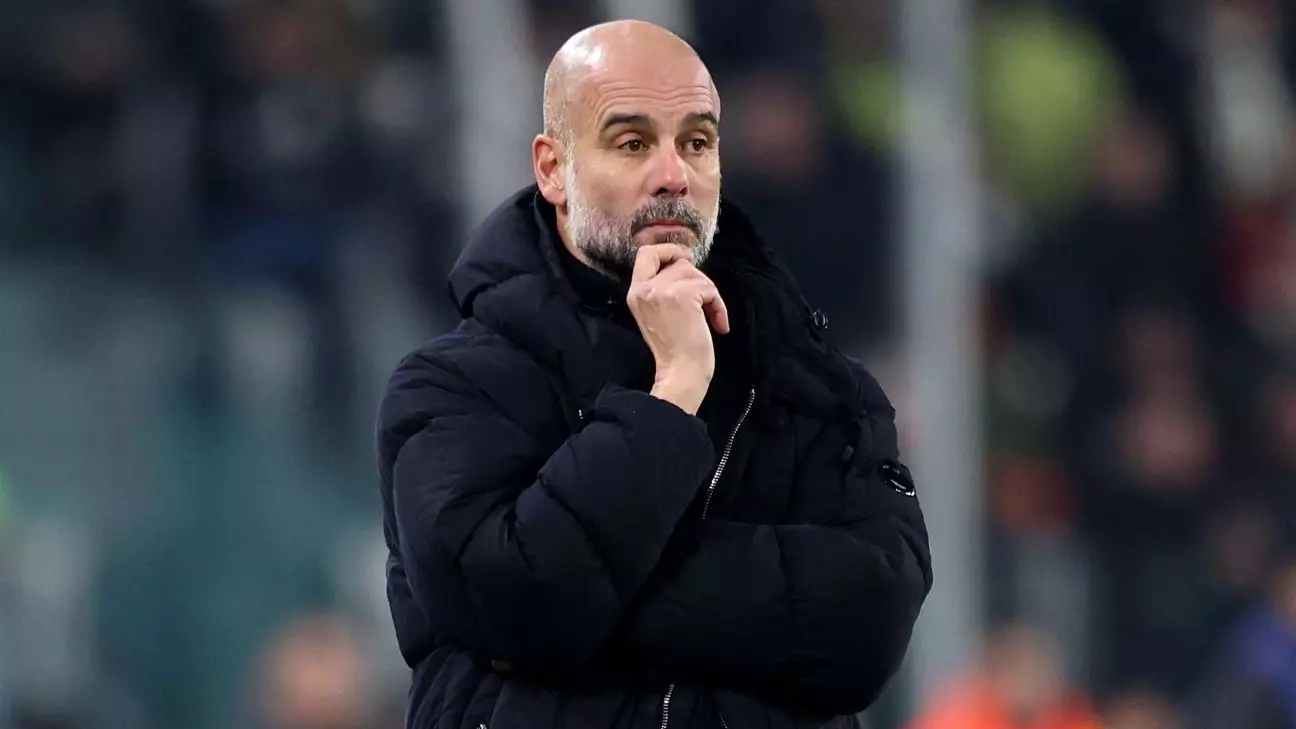
Amidst the upheaval, one of the most pressing questions is whether Guardiola’s stature as a manager is at risk. Given his illustrious tenure that has yielded 18 trophies since his arrival in 2016, it appears unlikely the club’s executives—led by chairman Khaldoon al-Mubarak—would react impulsively by dismissing him. Yet, Guardiola’s apparent detachment during the match in Turin leaves fans and critics questioning his ability to navigate his current crisis. With a resigned demeanor visible on the sidelines, where he frequently stood with hands in pockets, the once-animated manager was noticeably subdued, exemplifying a deep-seated struggle to find solutions.
Guardiola’s unease is further pronounced when considering his previous resilience against adversity. Throughout his career, he’s successfully maneuvered through challenging phases at Barcelona and Bayern Munich, yet he has never confronted such a steep decline in performance at City. The stark contrast between his past successes and the present crisis, most vividly illustrated during the Juventus encounter, poses an uneasy reflection: are we witnessing the unraveling of a manager known predominantly for his triumphs?
The match against Juventus revealed far more than merely a loss; it exposed significant cracks in Guardiola’s tactical decision-making. The manager’s hesitance to effect changes until late in the match raises eyebrows. The aging core of players like Kevin De Bruyne and Ilkay Gündogan, who struggled to control the midfield, went unaddressed for far too long. Guardiola’s substitutions, including the introduction of Matheus Nunes in the 87th minute, seem indicative of a larger issue—an inability or unwillingness to adapt in real time when faced with adversity.
City’s goal-scoring machine, Erling Haaland, also failed to make an impact, registering a mere 18 touches throughout the match, which only exacerbates the pressure on Guardiola. The challenge of revamping the squad, which has come to resemble a group of players devoid of youthful vigor and the trademark attacking dynamism city fans once adored, now looms large.
In the confines of the post-match press conference, Guardiola attempted to maintain a facade of composure. Acknowledging the precarious nature of his situation, he affirmed his commitment to navigate through this turbulent phase, asserting, “Of course I question myself and I have my thoughts.” Yet, his insistence that he is in the process of self-reflection, rather than despair, appears to mask growing uncertainty.
Despite having recently signed a two-year contract extension, Guardiola acknowledged his contemplation regarding the future, saying, “There were some moments I thought this should be my last one.” Such reflections tug at the heartstrings of City supporters, as they ponder whether Guardiola’s high standards are becoming too much to reconcile with the current realities on the pitch.
In every corner of the football world, questions are swirling: How long can he sustain this role amidst declining results? In the near term, as City gears up for a hectic schedule—including participation in the FIFA Club World Cup—it begs the question of whether Guardiola can rally his team back from the brink.
What remains is a sobering reality for Manchester City and their managerial icon—if the current trajectory persists, drastic changes may have to be contemplated. While relegation from the Champions League seems unthinkable for a club of City’s stature, pressing issues in both tactics and team morale lead to mounting pressure for Guardiola.
In the coming months, fans and football analysts will scrutinize every tactical decision, every substitution, and every press briefing. As the season unfolds, football enthusiasts worldwide will be keenly watching, hoping for a spark that rekindles the brilliance of Guardiola’s reign, but preparing for the possibility that this season may indeed signify the beginning of the end. In the world of elite football, even giants like Guardiola are not immune to the unforgiving nature of performance pressure.