
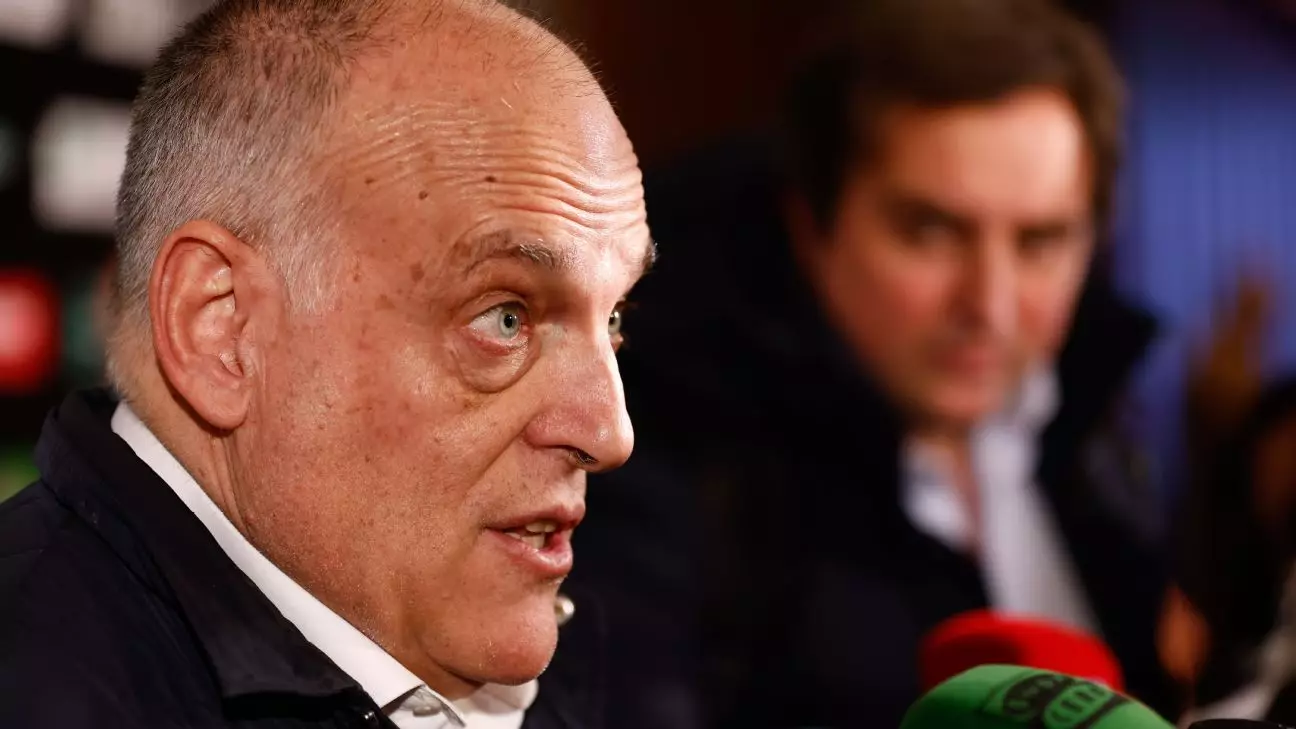
The relationship between LaLiga and its biggest club, Real Madrid, has reached a boiling point, as evidenced by the recent comments from LaLiga President Javier Tebas. In a candid interview, Tebas took aim at what he termed the “crying” behavior exhibited by Real Madrid regarding officiating in Spanish football. His remarks have once again highlighted the ongoing tensions between the club and the league, as well as the widespread implications for the integrity and perception of Spanish football.
Tebas’s statements suggest a frustration that transcends mere rivalry; they reflect a growing discontent with how Real Madrid’s leadership has framed their grievances. His use of the term “global conspiracy theory” emphasizes his view that the club is indulging in narratives that undermine the entire league. By painting a picture of systemic bias against them, Real Madrid not only positions itself as a victim but also detracts from the accomplishments of their competitors, raising questions about sportsmanship and responsibility within the realm of elite football.
The dynamics shift notably when considering the responses from the Real Madrid camp, which have been vocal and frequent in airing their dissatisfaction with refereeing decisions. The official channels utilized by the club amplify grievances, turning specific instances of perceived injustice into a broader narrative of victimization. This strategy has the potential to alienate other stakeholders in LaLiga, complicating relationships with both rivals and the league’s administration.
Central to this dispute are the formal complaints made by Real Madrid to the Royal Spanish Football Federation (RFEF) regarding officiating. This move has prompted a defensive stance from Tebas, who emphasized the necessity of protecting the competition’s integrity. He argues that Real Madrid’s claims of “manipulation and adulteration” inflict serious damage on the league’s image, suggesting that accusations from such a prominent club can have a long-lasting impact on the perception of official practices within Spanish football.
While it’s understandable that a club of Real Madrid’s stature would seek to protect its interests, one must consider the broader implications of such claims. They can create a hostile environment where the integrity of referees is constantly scrutinized, and every decision is analyzed through a lens of bias. This not only complicates relations between clubs but also impacts the morale of match officials, who could be driven to paralysis by the fear of backlash regardless of their decisions.
The atmosphere surrounding these contentious issues has spilled into the terraces, with Real Madrid supporters vocalizing their dissatisfaction through chants like “Tebas stop stealing from us.” While these displays of solidarity are aimed at galvanizing the team and expressing frustration, they also serve as a reminder of how deeply entrenched these conflicts are becoming. The orchestrated nature of these chants raises questions about their authenticity and reflects a broader mobilization of fan sentiment that can easily spiral out of control.
Tebas’s dismissal of these protests as “prepared” signals his belief that such actions are being driven by external influences rather than genuine fan emotion. This perception can be detrimental; it shrouds legitimate grievances in controversy, leading to further alienation among fans who might feel that their voices are being undermined or mischaracterized.
Adding another layer of tension is the controversy surrounding Dani Olmo, a player whose registration has become a hot topic amidst the ongoing financial scrutiny facing FC Barcelona. Tebas firmly believes that Olmo should not be allowed to run out the season with Barcelona, underscoring LaLiga’s stance on enforcing financial fair play regulations. His determination to ensure compliance is aimed at preserving the financial integrity of the league, yet it also reflects his broader objectives to maintain a level playing field across all clubs.
The intertwining of these narratives—the conflict with Madrid, the accusations of officiating bias, and the enforcement of registration rules—points to a fractured landscape in Spanish football. Each issue has the potential to impact the others, creating an environment of mistrust and confrontation that threatens to overshadow the game itself.
The ongoing tumult between LaLiga and Real Madrid illustrates a critical juncture for Spanish football. As these exchanges escalate, they challenge the foundational aspects of sportsmanship, fair play, and the sustainability of the league’s reputation. Moving forward, both the league and its most storied club must grapple with their responsibilities—to each other, to their fans, and to the sport as a whole—if they hope to restore a sense of equilibrium that allows for fair competition without the overshadowing drama of public disputes.