
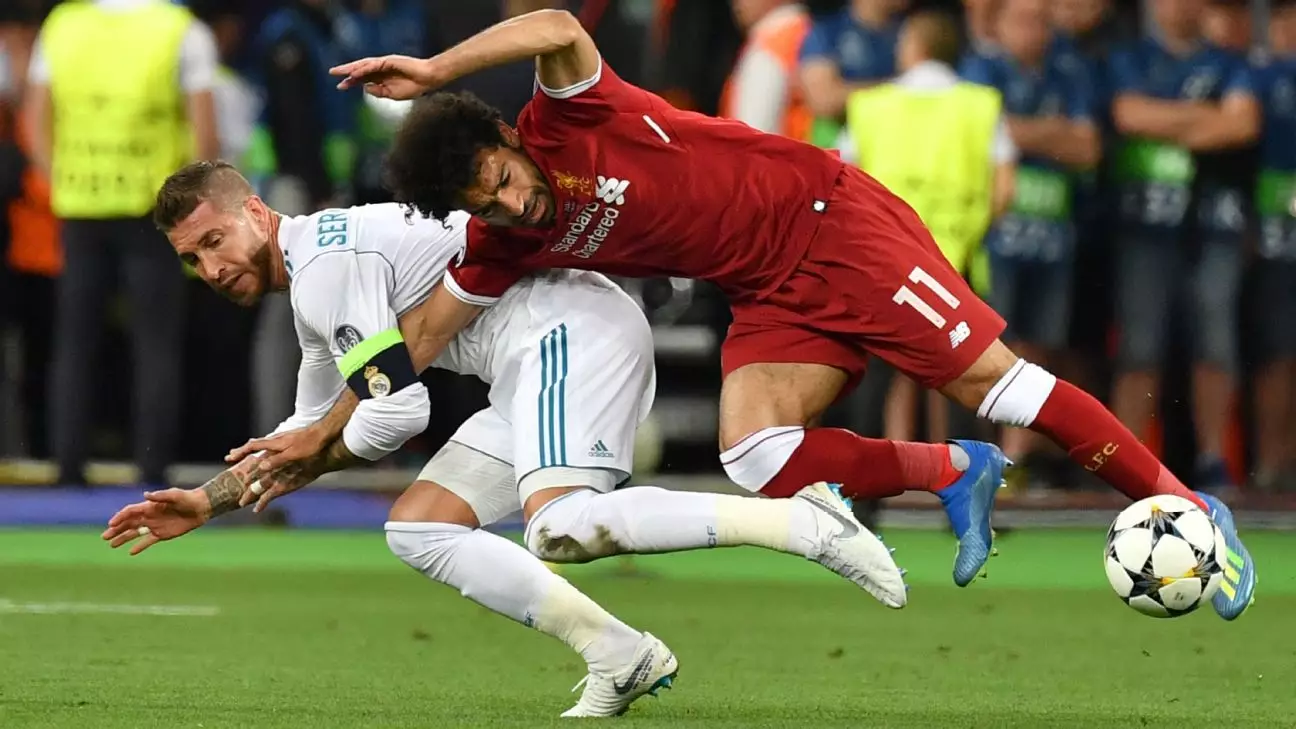
In the realm of football, rivalries often transcend the pitch, morphing into intense personal opinions between managers, players, and supporters. One such instance arose when former Liverpool executive Jürgen Klopp found himself embroiled in a spirited critique of Sergio Ramos. This assessment came during a conversation on Toni Kroos’ podcast where Klopp reflected on a segment of their shared football history that dramatically affected the outcome of a Champions League final. The incident in question, Ramos’s controversial challenge on Liverpool’s star player Mohamed Salah, continues to shape public perception and sporting discourse.
The 2018 Champions League final in Kyiv remains etched in the memories of fans of both clubs. Ramos’s tackle not only incapacitated Salah, leading to a significant shoulder injury but also altered the trajectory of the match, resulting in a 3-1 victory for Real Madrid. Klopp’s strong assertion that Ramos may not be as “good of a guy” as some portray him, stems from an emotional response to an event that many believe was intentional—not merely a momentary lapse in judgment on the pitch. His remarks highlight the lingering frustration from that fateful evening, suggesting that Ramos embodies a mentality Klopp finds troubling within the sport.
Klopp’s Leadership Philosophy
Klopp’s sentiments reflect a broader managerial philosophy that prioritizes integrity and sportsmanship. He expressed a categorical aversion to players who engage in actions he perceives as unsportsmanlike, emphasizing his commitment to fostering a team culture devoid of such attitudes. The former Liverpool manager’s avowal that he would ensure players embody a certain moral standard signals his belief in ethical play as integral to the fabric of football.
This perspective raises questions about current and former players’ values, especially regarding the fine line between competitive spirit and recklessness. Should footballers accept the risk of injuring opponents as part of the game, or should there be a universal adherence to safety and respect?
In the ensuing dialogue on the podcast, Kroos took the opportunity to defend his former teammate, insisting that Ramos possesses qualities that make him an exemplary locker room presence. This rebuttal introduces an interesting dichotomy: while Klopp emphasizes the importance of sportsmanship, Kroos offers a contrasting viewpoint, suggesting that teamwork and camaraderie play equally crucial roles in a player’s character.
Although Ramos remains a polarizing figure, Kroos’s praise suggests that the dynamics of any football team may accommodate a blend of personalities, including those that may not conform to traditionalist ideals held by coaches like Klopp.
Reflection on Careers and Legacies
As Klopp transitions to a new role at Red Bull, the opinions he shares will continue to resonate within the football community. His legacy as a transformative figure at Liverpool is unquestionable, and while discussions about Ramos may fade, they epitomize the romantic and often contentious nature of the sport. This dialogue serves as a reminder that behind the statistics and trophies lie personal beliefs that shape the narratives of football’s most illustrious characters.